Difference Between SYBR Green and TaqMan
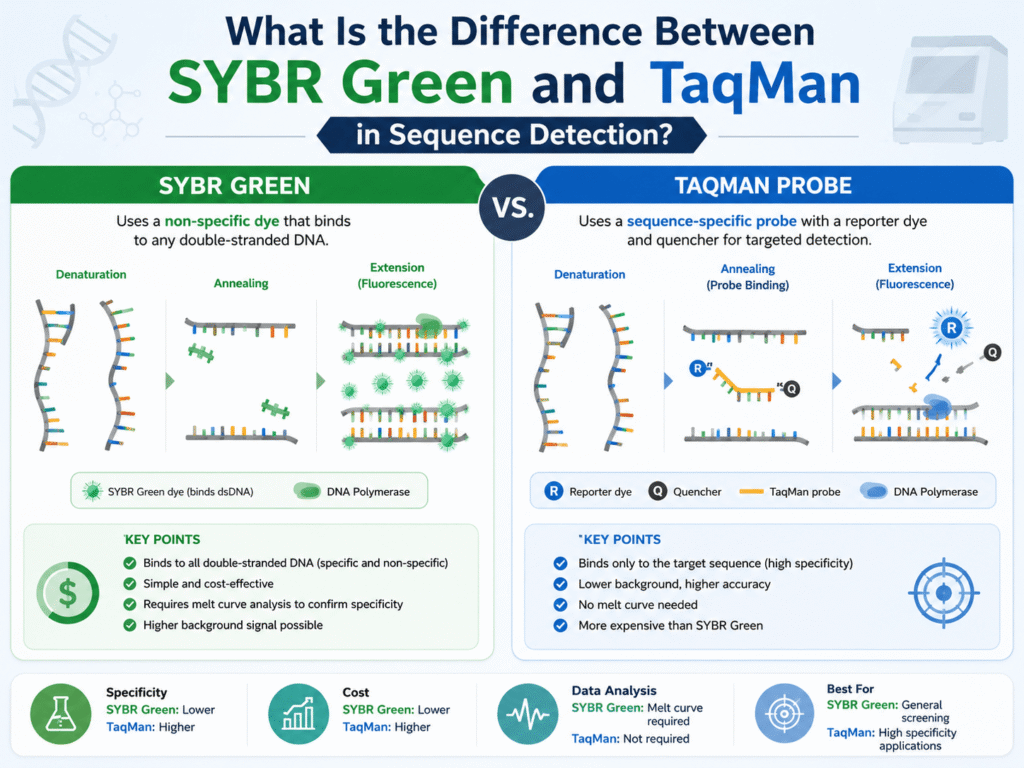
SYBR Green and TaqMan are two common fluorescence-based methods used in sequence detection, mainly in real-time PCR and qPCR. The short answer is simple: SYBR Green detects any double-stranded DNA that forms during amplification, while TaqMan detects a specific target sequence through a labeled probe.
That one difference changes almost everything.
SYBR Green is cheaper, easier to set up, and useful when a lab wants a simple way to measure amplification. TaqMan costs more because it needs a probe, but it gives stronger target confirmation and works better when specificity, multiplexing, or diagnostic confidence matter.
Both can produce strong qPCR data. The better choice depends on what the lab is trying to detect, how much certainty is needed, how many targets are being measured, and how much budget is available.
The Core Difference Comes Down to Dye-Based Detection vs Probe-Based Detection
SYBR Green is a dye-based detection method. TaqMan is a probe-based detection method. SYBR Green watches DNA accumulation in a broad way, while TaqMan watches a selected sequence with an added layer of target recognition.
In a sequence detection system, the goal is not just to make DNA copies. The system also needs to measure the signal that proves amplification is happening.
SYBR Green does this by binding to double-stranded DNA. As PCR creates more double-stranded DNA, fluorescence increases. The machine reads that rise in signal cycle by cycle.
TaqMan works differently. It uses two primers and a probe that is designed to bind inside the target region. The probe carries a reporter dye and a quencher. When the probe is intact, the quencher keeps the reporter signal low. During extension, DNA polymerase cleaves the bound probe, separating reporter from quencher. The reporter signal then rises.
So, SYBR Green asks, “Is double-stranded DNA increasing?”
TaqMan asks, “Is this exact target sequence being amplified?”
That is the practical divide.
How SYBR Green Works in Sequence Detection
SYBR Green works by attaching to double-stranded DNA and producing fluorescence after binding. During qPCR, each amplification cycle creates more double-stranded product, so the fluorescence signal rises as the target grows.
The appeal is easy to see. A SYBR Green assay usually needs only primers, master mix, sample, and cycling conditions. There is no need to order a target-specific probe.
That makes SYBR Green useful for early-stage research, screening many targets, checking primer behavior, or running gene expression experiments when cost needs to stay controlled.
The tradeoff is that SYBR Green cannot tell the machine whether the DNA came from the intended target, a non-specific product, or primer-dimers. If double-stranded DNA is present, SYBR Green can bind and glow.
This does not make SYBR Green unreliable by default. It means the assay needs careful primer design and a proper specificity check.
Melt curve analysis becomes a key part of SYBR Green workflows. After amplification, the system raises the temperature and measures how the DNA products melt. A clean, single melt peak often supports the idea that one main product was amplified. Multiple peaks may suggest non-specific products or primer-dimers.
SYBR Green can be excellent when the target is well characterized and the primers behave cleanly. It becomes riskier when the sample is complex, the target is rare, or closely related sequences may be present.
How TaqMan Works in Sequence Detection
TaqMan uses a target-specific hydrolysis probe in addition to the forward and reverse primers. The probe adds another recognition step between amplification and signal detection.
A typical TaqMan probe has a fluorescent reporter on one end and a quencher on the other. While both stay close together, the quencher suppresses the reporter signal.
During PCR, the probe binds to its matching sequence between the primers. As polymerase extends the new DNA strand, its 5′ nuclease activity cleaves the probe. That separation frees the reporter signal, and the qPCR instrument records fluorescence.
This mechanism makes TaqMan more selective than SYBR Green. The primers must work, and the probe must also bind correctly for the strongest signal to appear.
That extra layer is why TaqMan is often preferred for diagnostic assays, pathogen detection, mutation testing, copy number work, and other settings where the result needs more target confidence.
TaqMan is also a better fit for multiplex qPCR. Different probes can carry different reporter dyes, so one reaction can measure more than one target when the instrument supports those channels. SYBR Green usually struggles here because one dye signal cannot easily separate multiple targets in the same well.
The cost is the main drawback. Each assay needs a probe, and probe design adds time, expense, and planning. Still, many labs accept that cost when the result needs higher specificity.
Specificity Is Where TaqMan Pulls Ahead
Specificity refers to how well an assay detects the intended target without picking up the wrong product. In this area, TaqMan usually has the advantage because the probe must match the target sequence.
SYBR Green detects double-stranded DNA broadly. That makes it flexible, but also more open to false signal from primer-dimers or off-target amplification.
A primer-dimer is a small unwanted DNA product formed when primers bind to each other instead of the intended template. Since primer-dimers are double-stranded, SYBR Green can bind to them and create fluorescence.
That can push the signal upward even when the true target is weak or absent.
TaqMan is less vulnerable to that type of false signal because a random primer-dimer usually does not contain the probe-binding sequence. The probe is the extra checkpoint.
Still, TaqMan is not magic. Poor primer design, probe mismatch, sample inhibitors, contamination, or weak assay setup can still cause poor results. The difference is that TaqMan gives the assay one more target-specific barrier before fluorescence is counted as signal.
In plain lab terms, SYBR Green can tell you that DNA was made. TaqMan gives more confidence that the right DNA was made.
Cost and Setup Make SYBR Green The Better Option
SYBR Green is usually cheaper because it does not require a labeled probe. A lab can design primers, run the assay, check the melt curve, and refine conditions without paying for probe synthesis.
That makes SYBR Green attractive for:
- Early assay development
- Gene expression screening
- Teaching labs
- Budget-limited projects
- Testing many candidate targets
- Experiments where the target has already been checked well
The setup is also faster. If a lab already has validated primers, the assay can often move ahead without waiting for a custom probe.
TaqMan costs more because every target needs a probe. If a study covers many genes or many organisms, that cost can grow quickly.
Still, the higher upfront cost may save time later when the assay needs fewer rounds of troubleshooting, stronger target confirmation, or multiplex detection.
The cost question is rarely just “Which reagent is cheaper?” A better question is, “How expensive would a wrong or unclear result be?”
If the work is exploratory, SYBR Green may be enough. If the result affects diagnosis, treatment direction, contamination control, or release decisions, TaqMan often makes more sense.
TaqMan Is Usually Better for Multiplex Sequence Detection
Multiplex sequence detection means measuring more than one target in the same reaction. TaqMan is usually better suited for this because each probe can carry a different reporter dye.
A multiplex TaqMan assay might detect a pathogen target, an internal control, and a sample adequacy marker in one well. Each target gets its own probe and fluorescence channel.
This saves sample, reduces pipetting, and can shorten turnaround time.
SYBR Green is less suited for multiplexing because it produces one general double-stranded DNA signal. If two targets amplify in the same tube, the dye does not naturally tell them apart.
Melt curve analysis can sometimes help separate products with different melting temperatures, but that is not as clean as using different probe dyes. Products with similar length or sequence can have similar melt behavior, which creates interpretation problems.
That is why multiplex diagnostic assays often use probe-based chemistry.
SYBR Green can still be useful when each target is run in a separate well. It is simple, flexible, and cost-friendly. Once several targets need to be detected together, TaqMan becomes the cleaner choice.
Melt Curves Are a Big Part of SYBR Green Quality Control
Melt curve analysis helps check whether a SYBR Green assay produced one main DNA product or several products. Since SYBR Green binds to double-stranded DNA in general, this step gives the user a way to inspect product behavior after amplification.
A clean SYBR Green reaction often shows one sharp melt peak. That suggests one main product dominated the reaction.
Multiple melt peaks can point toward non-specific amplification. A low-temperature peak may suggest primer-dimers. A broad or messy peak may suggest the assay needs better primer design or cycling changes.
Melt curves are helpful, but they are not perfect. Two different products can sometimes melt at similar temperatures. A single melt peak does not always prove perfect sequence identity.
Agarose gel checks, sequencing, primer redesign, and no-template controls can all help when the result needs more confidence.
TaqMan assays do not rely on melt curves in the same way because the probe adds target-specific detection. Still, controls remain necessary. A probe-based assay can fail if the target sequence has variation in the probe-binding region, if inhibitors are present, or if the assay was designed poorly.
Good sequence detection is never only about the chemistry. It also depends on design, controls, sample quality, and interpretation.
Accuracy Depends on Assay Design, Not Just the Chemistry
It is tempting to say TaqMan is accurate and SYBR Green is less accurate. That is too simple.
Both methods can produce strong quantitative data when the assay is designed well. Both can also produce poor data when the assay is rushed.
SYBR Green depends heavily on primer quality. The primers must amplify the intended target efficiently without creating side products. The assay also needs melt curve review and proper controls.
TaqMan depends on primer and probe quality. The probe must bind to the correct sequence, avoid known variants when needed, and match the assay goal. A mismatch in the probe region can reduce signal or cause false negatives.
Amplification efficiency also matters for both methods. qPCR assays are usually expected to amplify with high efficiency across the tested range. Poor efficiency can distort quantification, even when the chemistry itself is sound.
The strongest sequence detection results come from a full workflow, not a single reagent choice.
That workflow includes clean sample handling, good extraction, primer and probe checks, no-template controls, positive controls, standard curves when needed, and careful review of amplification curves.
False Positives and False Negatives Look Different in Each Method
SYBR Green and TaqMan can both produce wrong results, but the failure patterns are not always the same.
With SYBR Green, false positives often come from non-specific products, primer-dimers, or contamination. Since the dye binds to any double-stranded DNA, unwanted amplification can still create a signal.
This is why no-template controls matter. If a no-template control amplifies, the signal may come from contamination or primer-dimers rather than real target DNA.
With TaqMan, false positives are less likely from simple primer-dimers because the probe must usually bind and be cleaved. Still, contamination with true target material can create a positive result. Poorly designed probes can also create background problems.
False negatives can happen in both systems.
A SYBR Green assay may miss the target if primers do not bind well, inhibitors block amplification, or the target amount sits below the detection limit.
A TaqMan assay may miss the target if mutations or sequence changes occur in the probe-binding region. This risk matters in pathogen detection, viral variant tracking, and mutation-sensitive assays.
So, TaqMan gives higher target confidence, but it also places more dependence on probe design. SYBR Green is broader and cheaper, but it asks the user to watch more closely for non-specific signal.
The Workflow Feels Different in a Real Lab
SYBR Green feels lighter at the setup stage. A lab can order primers, prepare the reaction, run qPCR, and inspect amplification plus melt curve data.
This makes it practical when researchers are still exploring targets. If one primer pair performs poorly, it can be replaced without redesigning a probe.
TaqMan feels more planned. The probe design needs care, the dye channels must match the instrument, and multiplex assays need more thought. The reaction may cost more, but the readout is often easier to interpret once the assay is validated.
In everyday use, SYBR Green may create more interpretation work after the run. The user may need to check melt peaks, primer-dimers, and non-specific products.
TaqMan shifts more work toward design before the run. After the run, the signal is usually cleaner because it is tied to probe cleavage.
Neither workflow is better for every lab.
A research lab screening 50 genes may prefer SYBR Green because it keeps cost manageable. A clinical lab confirming a pathogen may prefer TaqMan because clearer target detection is worth the added cost.
SYBR Green Works Well for Simple, Clean, and Cost-Sensitive Assays
SYBR Green is a strong choice when the target is known, the primers are clean, and the user can review melt curves carefully.
It fits many routine qPCR and gene expression workflows. It also works well when a lab wants to compare many targets without paying for probes for each one.
The method is especially useful during assay development. Researchers can test primer pairs, check amplification behavior, and narrow down the best target regions before moving to a probe-based format.
SYBR Green may also be enough when the sample type is simple and the risk of closely related off-target amplification is low.
The method becomes less appealing when specificity is hard to prove. Complex samples, low-copy targets, mixed microbial samples, and clinical decision-making can all raise the risk of unclear interpretation.
In those settings, the lower reagent cost may not be worth the extra uncertainty.
TaqMan Works Well When Specificity and Confidence Matter More Than Cost
TaqMan is a strong choice when the assay needs target-specific detection, multiplexing, or cleaner interpretation.
It is widely used in diagnostic-style qPCR, pathogen detection, mutation assays, copy number analysis, and applications where false signal can create serious problems.
The probe adds cost, but it also adds confidence. The assay does not rely only on double-stranded DNA formation. It requires amplification of the target region and probe binding within that region.
This makes TaqMan useful when the target sits among similar sequences. It also helps when the lab needs an internal control in the same reaction.
TaqMan is not always needed for basic research. If the goal is simple expression screening and the primers are well tested, SYBR Green may be perfectly reasonable.
The best reason to choose TaqMan is not that it sounds more advanced. The best reason is that the experiment needs the extra sequence-specific checkpoint.
Side-by-Side Comparison of SYBR Green and TaqMan
| Feature | SYBR Green | TaqMan |
| Detection type | Dye-based | Probe-based |
| Signal source | Any double-stranded DNA | Cleaved target-specific probe |
| Main components | Two primers and dye mix | Two primers and labeled probe |
| Specificity | Lower, depends heavily on primer behavior | Higher, due to probe binding |
| Primer-dimer risk | Can produce signal | Less likely to produce true probe signal |
| Melt curve use | Common and highly useful | Usually not central |
| Multiplexing | Limited | Stronger fit |
| Cost | Lower | Higher |
| Setup speed | Faster | Slower due to probe design |
| Best use | Screening, routine expression work, simple targets | Diagnostics, multiplex assays, mutation or pathogen detection |
| Main weakness | Detects unwanted double-stranded DNA | Higher cost and probe design burden |
This table gives the basic picture, but the final choice should follow the experiment.
A low-cost assay is not useful if it produces unclear results. A high-specificity assay is not necessary if the target is simple and the budget is tight.
Which One Should a Lab Choose?
Choose SYBR Green when the goal is low-cost, flexible sequence detection and the assay can be checked with melt curves and controls.
Choose TaqMan when the result needs higher target confidence, multiplexing, or cleaner detection in complex samples.
A common path is to start with SYBR Green during early research, then move to TaqMan when the target becomes part of a well-designed and tested assay workflow. This gives the lab room to test ideas cheaply before paying for probe design.
That said, some labs start with TaqMan from day one because the stakes are already high. A pathogen detection assay, a diagnostic-style panel, or a mutation-specific test may not be a good place to begin with broad dye-based detection.
The decision comes down to five practical questions:
- Is the target simple or surrounded by similar sequences?
- Does the assay need to detect more than one target in the same well?
- Can melt curve analysis give enough confidence?
- How costly would a false positive or false negative be?
- Is the project still exploratory, or is it moving toward a validated workflow?
When the answers point toward speed and budget, SYBR Green often wins.
When the answers point toward specificity and confidence, TaqMan usually wins.
A Simple Way to Remember the Difference
SYBR Green is like a light that turns on when double-stranded DNA appears. It is simple, sensitive, and affordable, but it does not know whether the DNA is exactly the product you wanted.
TaqMan is like a lock-and-key signal. The primers start the reaction, but the probe adds a second layer of recognition. The signal rises when the correct probe-bound target is copied and cleaved.
That is why SYBR Green is often loved in research labs, while TaqMan is often trusted in settings where the target call needs more certainty.
Both methods belong in sequence detection. They just answer slightly different needs.
SYBR Green gives speed, flexibility, and lower cost.
TaqMan gives specificity, multiplexing, and cleaner target confirmation.
A lab that understands this difference can choose the method that fits the sample, the target, and the risk behind the result.