Why Is NGS more efficient than Sanger sequencing
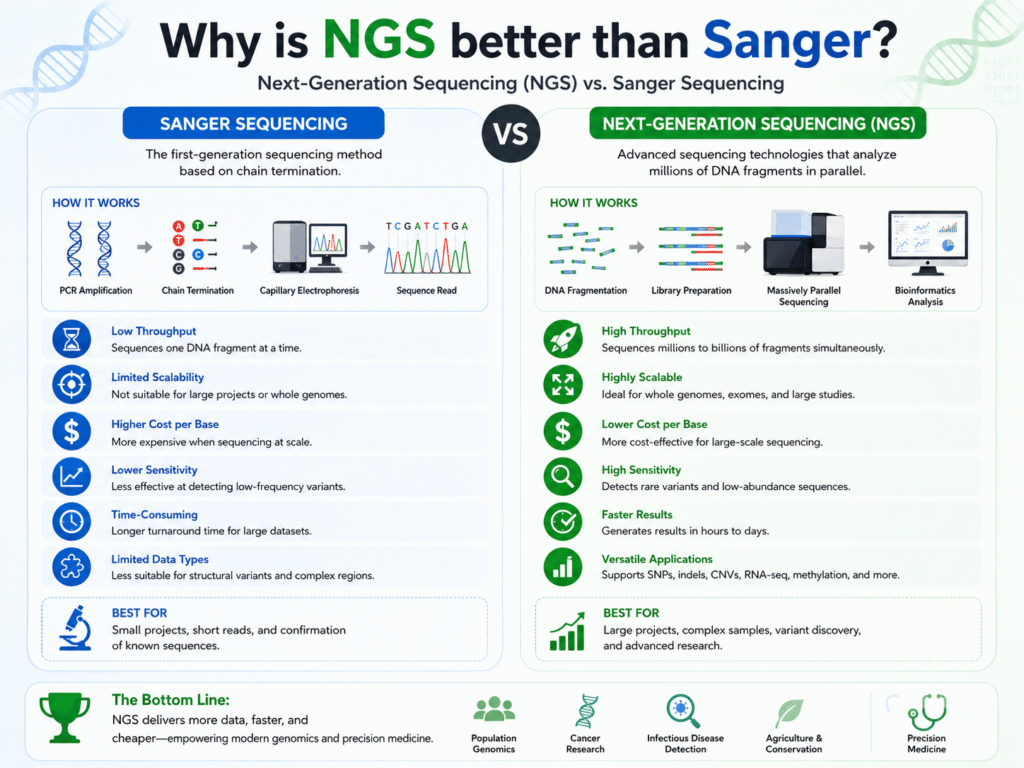
Next-generation sequencing is better than Sanger sequencing when a lab needs to read many genes, many samples, or many variants at the same time. Sanger sequencing is still trusted for small, targeted DNA checks, but it was built for a slower, one-region-at-a-time style of work.
NGS changed that. It can read millions of DNA fragments in parallel, which makes it stronger for cancer panels, inherited disease testing, infectious disease tracking, microbiome studies, and large research projects.
NGS is better than Sanger because it gives more genetic information in one test, finds low-level variants more easily, handles bigger projects at lower cost per base, and reduces the need for repeated single-gene testing.
Still, “better” depends on the job. If the question is small, Sanger may be enough. If the question is wide, complex, or unknown, NGS usually gives the lab a much clearer answer.
NGS vs Sanger Sequencing: Detailed Comparison
| Feature | Sanger Sequencing | Next-Generation Sequencing (NGS) | Why It Matters |
| Sequencing approach | Sequences individual DNA fragments in separate reactions | Sequences millions of DNA fragments in parallel | NGS can analyze far more genetic information in a single sequencing run |
| Throughput | Low to moderate | Very high | NGS is better suited for projects involving many genes, samples, or genomic regions |
| Number of targets | Best for one or a small number of targeted regions | Can analyze hundreds to thousands of genes, whole exomes, or whole genomes | NGS reduces the need to perform multiple sequential tests |
| Best use case | Small, well-defined sequencing targets | Broad or complex genetic analysis | The right method depends on whether the question is narrow or genome-wide |
| Sequencing depth | Limited because each reaction analyzes a specific template | Can generate hundreds or thousands of reads covering the same genomic position | Greater depth can improve confidence and help detect variants present at low frequencies |
| Low-frequency variant detection | Generally less sensitive for variants present at low allele frequencies | Can detect lower-frequency variants when sufficient sequencing depth and validated methods are used | This can be important in tumor sequencing, mixed microbial populations, and heterogeneous samples |
| Variant discovery | Most useful when the region or suspected variant is already known | Can identify expected and unexpected variants across many regions | NGS is more suitable for discovery-oriented research and broad diagnostic investigations |
| Types of variants detected | Primarily single-nucleotide variants and small insertions/deletions within the sequenced region | Depending on the assay and bioinformatics pipeline, can detect SNVs, small indels, copy-number changes, fusions, and some structural variants | NGS can provide a more comprehensive view of genetic variation |
| Multiplexing | Limited compared with NGS | Many samples and targets can be barcoded and analyzed together in the same run | Multiplexing increases laboratory efficiency and reduces cost per sample at scale |
| Cost per sequencing run | Usually lower for small targeted projects | Often higher because of instrumentation, reagents, and data-analysis requirements | Sanger can remain more economical when only a few regions need to be tested |
| Cost per base or target at scale | Becomes relatively expensive as the number of targets increases | Usually decreases substantially as more targets and samples are analyzed together | NGS becomes increasingly cost-effective for large sequencing projects |
| Sample requirements | Separate reactions may be required for multiple targets | Multiple targets can often be analyzed from the same DNA or RNA sample | This is useful when sample material is limited, such as small biopsies |
| Turnaround for many genes | Can become slow because targets are processed through multiple individual reactions | Many targets can be analyzed simultaneously | NGS can reduce the time required for large multi-gene investigations |
| Read length | Typically provides relatively long individual reads, often several hundred bases | Read length varies by platform and is often shorter for common short-read NGS systems | Sanger remains useful when a clean, relatively long read from a defined region is needed |
| Data volume | Produces relatively small and manageable datasets | Produces very large datasets | NGS requires more computational storage, processing, and data management |
| Bioinformatics requirements | Minimal compared with NGS | Usually requires specialized software, pipelines, databases, and expertise | Data analysis is one of the major practical challenges of NGS |
| Workflow complexity | Relatively simple and well established | More complex library preparation, sequencing, quality control, and analysis workflow | Laboratories need validated workflows and appropriate technical expertise |
| Interpretation complexity | Usually straightforward when sequencing a known region | Can identify large numbers of variants that require filtering and interpretation | More data can provide more answers, but it can also create additional interpretation challenges |
| Rare-disease testing | Useful for confirming specific suspected variants or sequencing individual genes | Useful for multi-gene panels, whole-exome sequencing, and whole-genome sequencing | NGS can investigate many potential disease-causing genes simultaneously |
| Cancer genomics | Useful for targeted confirmation or testing a small number of known regions | Well suited to multi-gene tumor panels and detection of multiple clinically relevant alterations | Tumors may contain multiple mutations and genetically distinct cell populations |
| Infectious-disease applications | Useful for sequencing specific microbial genes or confirming defined targets | Can support whole-genome sequencing, outbreak investigation, surveillance, metagenomics, and analysis of mixed populations | NGS provides broader information about pathogens and their genetic diversity |
| Microbiome and metagenomic analysis | Not practical for highly complex mixed communities | Can sequence DNA from many organisms within the same sample | NGS enables analysis of complex microbial communities that cannot realistically be resolved by individual Sanger reactions |
| Scalability | Limited as the number of samples and targets increases | Highly scalable | NGS is generally more efficient for large research, clinical, and surveillance programs |
| Accuracy considerations | Produces highly accurate sequence data for clean, defined templates | Accuracy depends on the platform, depth, library preparation, and bioinformatics pipeline | NGS should not automatically be described as universally “more accurate”; its major advantages are scale, depth, and sensitivity |
| Confirmation of known variants | Frequently useful for confirming specific variants or small targeted regions | Often unnecessary for every finding when an NGS assay has been appropriately validated, although confirmation practices depend on the laboratory and application | Sanger still has an important role in targeted verification workflows |
| Instrumentation | Generally less demanding and simpler to operate | Requires specialized sequencing instruments and supporting infrastructure | NGS involves greater initial investment and technical requirements |
| Overall advantage | Excellent for small, focused, well-defined sequencing tasks | Best when many genes, samples, variants, or genomic regions must be analyzed simultaneously | NGS is not universally better than Sanger; it becomes more advantageous as the scale and complexity of the sequencing question increase |
Sanger sequencing is often the better choice when only one or a few specific DNA regions need to be examined. NGS becomes more advantageous when the goal is to analyze many genes, many samples, complex mixtures, or large portions of the genome at the same time.
What is the main difference between NGS and Sanger sequencing?
The main difference between NGS and Sanger sequencing is scale. Sanger sequencing reads one DNA region at a time, while NGS reads millions of DNA fragments in parallel during the same run.
Sanger sequencing, also called chain-termination sequencing, has been one of the most trusted DNA sequencing methods for decades. It produces clean, readable results for short DNA regions. Many labs still use it when they already know the exact gene or variant they want to check.
NGS works in a different way. Instead of reading one target from one sample in a mostly linear process, it breaks DNA into many fragments, prepares those fragments as a sequencing library, and reads them at the same time. The result is a large data set that can cover a small gene panel, the exome, the transcriptome, a microbial genome, or even a whole human genome.
That difference changes the way labs think. With Sanger, the lab often asks, “Is this one region changed?” With NGS, the lab can ask, “What changes are present across all these genes, samples, or organisms?”
That wider view is the main reason NGS has become the preferred choice in many modern sequencing workflows.
Why do researchers use NGS instead of Sanger sequencing?
NGS is better than Sanger sequencing for large, complex, and high-volume work because it can test many targets at once, produce deeper coverage, detect low-frequency variants, and lower the cost per base when many regions must be sequenced.
The best way to understand the advantage is to look at what happens inside a real lab. A single-gene question may not need NGS. A cancer panel with dozens or hundreds of genes usually does. A small confirmation test may fit Sanger. A rare disease case with several possible genes usually needs broader coverage.
NGS can sequence many genes at the same time
NGS can read hundreds or thousands of genes in one run, while Sanger is usually used for one DNA region or a small number of regions at a time.
This is one of the biggest reasons labs move from Sanger to NGS. Many diseases are not caused by one simple genetic change. Breast cancer risk, hearing loss, epilepsy, cardiomyopathy, immune disorders, inherited retinal disease, and many tumor types can involve many genes.
With Sanger sequencing, testing many genes can become slow because each region needs separate primer design, amplification, sequencing, review, and follow-up. The process can work well for one known variant, but it becomes heavy when the lab must check many possible causes.
NGS solves that problem by grouping many targets into one test. A hereditary cancer panel, for example, can look across BRCA1 and BRCA2, TP53, PALB2, PTEN, ATM, CHEK2, and many other genes at the same time. A tumor panel can check multiple driver genes from one sample instead of testing one marker after another.
This broader testing style is useful because biology rarely follows a neat script. A patient’s symptoms may point to several possible genes. A tumor may carry more than one relevant change. A pathogen sample may include mixed genetic signals.
NGS gives the lab room to look wider without running a long chain of separate Sanger reactions.
NGS gives much higher throughput
NGS gives higher throughput because it can process many DNA fragments and many samples during the same sequencing run.
Throughput simply means how much sequencing work a system can handle. Sanger sequencing has lower throughput because the method reads a single amplified DNA fragment per reaction. It is accurate, but it does not scale well when the lab has hundreds of targets or many patient samples.
NGS was built for parallel reading. A single run can produce a large amount of sequence data. In practice, this allows labs to batch samples, barcode them, and process them together. Each barcode works like a sample tag, so the data can be sorted after sequencing.
This makes a major difference in busy labs. A research group studying many bacterial isolates can sequence them together. A clinical lab running a gene panel can process many patient samples in a batch. A public health lab can track many viral genomes across time and location.
Higher throughput also helps reduce bottlenecks. Instead of asking technicians to repeat the same single-region workflow again and again, NGS moves much of the work into library preparation, sequencing, and data analysis.
That does not mean NGS is simple. It requires planning, clean sample handling, and strong analysis pipelines. Yet when the workload is large, NGS gives a much better match for the volume.
NGS is better for detecting low-frequency variants
NGS is better for detecting low-frequency variants because it can read the same DNA region many times, giving deeper coverage than a typical Sanger trace.
This is especially useful in cancer, viral sequencing, mixed infections, mosaic genetic findings, and samples where the variant is present in only a small share of DNA molecules.
Sanger sequencing reads a mixed signal as a trace. If a variant is present at a low level, the signal may be buried under the stronger normal sequence. In many routine settings, Sanger is not reliable when the variant is only a small fraction of the sample.
NGS can generate many reads over the same position. If 1,000 reads cover one base, and 40 of those reads carry a variant, the analysis software can flag that signal as a possible low-frequency change. The lab can then review quality scores, strand balance, read depth, and error patterns.
This kind of depth gives NGS a clear advantage for tumor samples. Cancer tissue is often mixed with normal cells, immune cells, dead tissue, and other material. A mutation may be present in only part of the tumor. Sanger may miss it. NGS has a better chance of finding it when the test is designed with enough coverage.
The same advantage can appear in infectious disease work. Viruses and bacteria can exist as mixed populations. A resistant subpopulation may begin at a low level before it becomes dominant. High-depth NGS methods can help reveal that hidden variation earlier than a single consensus-style read.
NGS can find more types of genetic changes
NGS can detect many types of genetic changes, including single nucleotide variants, insertions, deletions, copy number changes, fusions, and larger structural changes, depending on the platform and test design.
Sanger sequencing is strong for small sequence changes in a defined region. It can show a base substitution, a small insertion, or a small deletion when the target is clean and known. But it is not the best tool when the lab needs a wider view of different variant types.
NGS can be designed in several ways. A targeted DNA panel may focus on single nucleotide variants and small insertions or deletions. A broader panel may add copy number analysis. RNA sequencing can detect gene fusions and expression changes. Whole-genome sequencing can give a wider view of structural variation.
This flexibility makes NGS more useful for complex cases. In cancer testing, one tumor may need checks for point mutations, exon skipping, amplifications, deletions, and fusions. Running separate Sanger tests for each possible change would be slow and incomplete.
NGS also helps when the lab does not know which type of change to expect. A patient with a rare inherited disorder may have a small variant in one gene, a deletion across several exons, or a splice-related change. A broader sequencing approach gives the lab more ways to find the cause.
The final result still depends on the assay. Not every NGS test detects every variant type. The advantage is that NGS gives labs far more design options than Sanger.
NGS becomes more cost-effective for large tests
NGS becomes more cost-effective than Sanger when the test includes many genes, many samples, or large DNA regions.
Sanger sequencing can be cheaper for a small job. If a lab only needs to check one variant in one sample, Sanger may be the practical choice. It has a familiar workflow, simple data review, and less need for heavy analysis.
The cost picture changes when the lab must test many targets. Each Sanger reaction adds labor, reagents, time, and review. A panel with 50 genes can turn into a long list of separate reactions. At that point, NGS usually becomes the better financial choice because many targets can be combined into one run.
The fall in sequencing cost over the past two decades also changed expectations. Whole genomes once cost a huge amount of money to sequence. Modern high-throughput methods brought the cost per base down so far that broad sequencing became realistic for research and many clinical settings.
Cost should not be judged only by the sequencing machine. A lab also needs to think about sample prep, controls, data storage, analysis, reporting, staff training, instrument use, repeat testing, and failed runs.
Even with those costs, NGS often wins when the question is broad. It can replace many separate Sanger tests with one planned workflow and one data review process.
NGS uses sample material more efficiently in many workflows
NGS can be better when sample material is limited because one prepared library can support testing across many targets.
This can be valuable in oncology, prenatal research, infectious disease testing, ancient DNA work, forensic studies, and small biopsy samples. Some samples are hard to collect. Some are degraded. Some exist in tiny amounts.
Sanger sequencing usually needs target-specific amplification for each region. When the lab must test many regions, the sample may be split across many reactions. That can become a problem when DNA quantity is low.
NGS workflows can often start with a limited amount of DNA or RNA and then use that material to build a library for many targets. This does not make sample quality irrelevant. Poor extraction, damaged DNA, inhibitors, and contamination can still hurt the result. But NGS gives labs a better route when they need to ask many questions from one small sample.
This is one reason targeted NGS panels became common in cancer testing. A small biopsy may be the only available tumor material. Repeating single-gene tests can waste tissue. A well-planned NGS panel can use that sample more carefully and return a broader result.
That broader result can save time too. When a lab gets multiple answers from one sample, clinicians and researchers do not have to keep going back for more tissue or more blood unless the case truly needs it.
NGS gives deeper data for complex samples
NGS gives deeper data because it records many sequence reads across many positions, which helps labs study mixed or complex samples with more detail.
Complex samples are common. A tumor sample can contain normal cells and multiple cancer clones. A respiratory sample can carry more than one pathogen. A microbiome sample can include hundreds of organisms. A viral sample can contain a swarm of related variants.
Sanger sequencing tends to show the dominant signal. That is enough when the sample is clean and the question is narrow. It is less helpful when the real answer is mixed.
NGS can split that mixture into many reads. Those reads can then be counted, mapped, grouped, and compared. In a microbiome sample, this can help identify organisms present at different levels. In a viral population, it can show minor variants. In a tumor, it can help reveal subclonal changes.
This deeper view is one reason NGS is so useful in research. It does not just answer whether a known position has changed. It can show patterns across genes, pathways, samples, and populations.
The tradeoff is that deeper data needs careful review. More data can also mean more noise, more uncertain findings, and more analysis work. NGS is better when the lab has the tools and skill to make sense of that data.
NGS reduces repeated single-gene testing
NGS reduces the need for repeated single-gene testing because many targets can be checked together in one planned assay.
This benefit is easy to feel in real clinical work. A patient may have symptoms that overlap several conditions. A tumor may need several markers to guide therapy. A pathogen may need typing, resistance screening, and outbreak tracking.
With Sanger, the lab may test one gene, wait for the result, then test another gene if the first answer is negative. This step-by-step process can take time. It can also create frustration because each negative result sends the case back to the start.
NGS changes the workflow. A panel can test the most relevant genes together from the beginning. If the first suspected gene is negative, the data from other genes is already available. This can shorten the diagnostic path and reduce repeated sample handling.
This is especially helpful in inherited disease testing. Many conditions show genetic heterogeneity, which means the same symptom pattern can come from different genes. Testing one gene at a time can miss the real cause for too long.
NGS does not remove the need for careful interpretation. A broader test may find variants of uncertain meaning. The lab and clinician still need to connect the result with the patient’s history. But the wider first pass can save time when many genes are plausible.
NGS supports discovery when the target is not fully known
NGS is better for discovery because it can search across many genetic regions without requiring the lab to know the exact target in advance.
Sanger sequencing works best when the lab already knows where to look. That makes it useful for confirming a known familial variant, checking a short PCR product, or reading a specific gene region.
NGS is stronger when the target is partly unknown. Researchers can use whole-exome sequencing to focus on protein-coding regions, whole-genome sequencing to look across the genome, RNA sequencing to study expression and fusions, or metagenomic sequencing to look for organisms without choosing one pathogen first.
This matters in rare disease research. A child may have a suspected genetic condition, but the exact gene may not be obvious. A broad NGS test can search many candidate genes in one run.
It is also important for infectious disease. A patient may have symptoms of infection, but routine targeted tests may be negative. Metagenomic NGS can help look for bacteria, viruses, fungi, or parasites in a less target-limited way.
Discovery power is one of the clearest reasons NGS moved beyond being a faster version of Sanger. It gives labs a different way to ask biological questions.
NGS is better for cancer panels and precision medicine
NGS is better for many cancer panels because tumors often need broad testing across multiple genes and variant types.
Cancer is rarely a single-marker problem. A lung cancer sample, for example, may need testing for EGFR, ALK, ROS1, BRAF, MET, RET, NTRK, KRAS, ERBB2, and other markers depending on the clinical setting. Some markers are point mutations. Some are fusions. Some are exon skipping events or copy number changes.
Sanger sequencing cannot handle that range in a practical way on its own. It may detect a known mutation in one region, but it does not give the broad view many cancer cases need.
NGS panels can check many cancer-related genes from one sample. This helps labs find driver mutations, resistance mutations, and co-occurring changes. It can also help when tissue is limited, because one test can cover many possible markers.
The benefit is not only speed. A broad panel can reveal options that would not be tested if the lab used a narrow one-gene-at-a-time method. That can matter when treatment decisions depend on matching a tumor’s molecular profile.
NGS is not perfect for every cancer sample. Poor tissue quality, low tumor content, and technical limits can still affect results. Yet for broad tumor profiling, NGS is usually far more useful than Sanger.
NGS is better for infectious disease surveillance
NGS is better for infectious disease surveillance because it can track pathogen genomes, identify variants, compare outbreaks, and study mixed microbial samples.
Sanger sequencing can read a target region from a pathogen. That can help in basic typing or confirmation. But public health work often needs a wider view. Labs may need to compare whole genomes, follow mutation patterns, track transmission, or find a pathogen when targeted tests do not give an answer.
NGS can support all of that. During viral outbreaks, genome sequencing can show how strains are related. In bacterial surveillance, whole-genome sequencing helps compare isolates and detect antimicrobial resistance genes. In metagenomic testing, NGS can search for genetic material from many organisms in one sample.
This wider view has become part of modern public health. It helps teams see whether cases are linked, whether a pathogen is changing, and whether resistant strains are spreading.
Sanger still has a place in smaller confirmation tasks. But for surveillance, outbreak work, and mixed infection research, NGS gives the scale and detail that public health labs need.
Is NGS always better than Sanger?
NGS is not always better than Sanger. Sanger sequencing is still useful when the lab needs a simple, low-volume, targeted answer from a known DNA region.
This is where balance matters. NGS is stronger for broad testing, but Sanger remains valuable in many daily lab tasks.
A lab may choose Sanger when it needs to confirm a known variant in a family member. It may use Sanger to read a plasmid insert, check a PCR product, or verify a short DNA region after cloning. It may also use Sanger when only one or two targets are needed and the lab wants a fast, familiar workflow.
Sanger data is also easier to review by eye. A clean chromatogram can give a clear answer for a defined region. NGS data needs bioinformatics, quality filters, reference mapping, variant calling, and reporting rules.
That extra analysis is worth it when the question is large. It may be unnecessary when the question is small.
A simple way to think about it is this: Sanger is like reading one selected paragraph very carefully. NGS is like scanning the whole chapter, or sometimes the whole book, with enough depth to compare many details at once.
Both tools can be right. The better choice depends on the question.
When should a lab choose NGS over Sanger?
A lab should choose NGS over Sanger when it needs broad coverage, high throughput, low-frequency variant detection, many-gene testing, mixed-sample analysis, or discovery beyond a known target.
NGS is often the better option for gene panels, whole-exome sequencing, whole-genome sequencing, tumor profiling, infectious disease surveillance, microbial genomics, transcriptome studies, and rare disease cases.
It is also a better fit when testing one gene at a time could delay the answer. A patient with symptoms that overlap many genetic disorders may benefit from a panel instead of a long chain of single-gene tests. A tumor sample with limited tissue may benefit from one broad assay instead of several separate tests.
NGS also makes sense when the lab wants to compare many samples. Population studies, outbreak tracking, and large research projects need scale. Sanger can produce strong single-read data, but it cannot match NGS for large batches.
The lab should still plan carefully. NGS needs good sample quality, proper controls, clear reporting rules, staff training, data storage, and analysis pipelines. A badly designed NGS test can still miss the answer.
NGS is best when the lab’s question is broad enough to make the extra setup worthwhile.
When is Sanger sequencing still the better choice?
Sanger sequencing is still the better choice for small, targeted sequencing tasks where the lab already knows the region of interest and does not need broad genetic coverage.
This includes checking a known familial mutation, confirming a short PCR product, reading a plasmid insert, testing a small number of amplicons, or resolving a simple variant question in a clean sample.
Sanger can also be useful when a lab does not have access to NGS infrastructure. Not every lab needs a sequencing platform, a data pipeline, or a variant interpretation team. For small projects, Sanger can be quicker to set up and easier to explain.
Another strength is read length. Standard Sanger reads can cover several hundred bases with high-quality sequence. That can be helpful for certain small-region tasks. Some NGS platforms produce shorter reads, though long-read sequencing has changed this part of the field in many areas.
The point is not that Sanger is outdated or useless. It is just no longer the best tool for many broad sequencing questions.
Sanger is still a reliable method when the question is narrow. NGS is better when the question is bigger than one region.
What are the main limitations of NGS?
NGS has limitations, including higher setup needs, more complex data analysis, possible uncertain findings, storage demands, and assay-specific blind spots.
The biggest practical challenge is data. NGS can produce huge amounts of sequence information. That data must be cleaned, mapped, filtered, checked, stored, and interpreted. Labs need software, trained staff, quality controls, and clear reporting rules.
Another issue is that more data can bring more uncertainty. A broad test may find a variant of uncertain meaning. That result may not clearly explain a disease or guide treatment. In clinical settings, this can create difficult conversations.
NGS tests also vary. A small targeted panel is not the same as whole-exome sequencing. Short-read sequencing is not the same as long-read sequencing. DNA sequencing is not the same as RNA sequencing. Each method has its own strengths and weak spots.
Some genomic regions are hard to sequence or map. Repetitive DNA, pseudogenes, GC-rich regions, structural variants, and low-quality samples can all create problems. A test may need another method to fill a gap.
Cost can also be a barrier when the sample number is low. NGS often becomes cost-effective at scale, but a single small target may still be cheaper by Sanger.
These limits do not erase the value of NGS. They simply mean that labs must match the method to the question.
How does NGS improve clinical and research decisions?
NGS improves clinical and research decisions by giving a wider, deeper view of genetic information from one test.
In clinical genetics, NGS can shorten the search for a diagnosis when many genes may be involved. A broader panel can reduce the need for repeated testing and may help find the cause of a rare condition faster.
In oncology, NGS can reveal tumor markers that guide therapy choice, clinical trial matching, resistance tracking, or prognosis. A single tumor sample may carry several relevant changes, and NGS is better suited to finding them together.
In infectious disease, NGS can help identify pathogens, track outbreaks, study resistance, and watch how organisms change over time. This is useful for hospitals, research centers, and public health programs.
In research, NGS lets scientists study genomes, transcriptomes, epigenetic patterns, microbial communities, and mixed populations at a scale Sanger cannot match. This has changed fields such as cancer biology, human genetics, microbiology, agriculture, evolutionary biology, and drug development.
The value comes from seeing more of the genetic picture at once. When the picture is larger, decisions can become more informed, especially in cases where a narrow test would miss part of the story.
Is NGS more accurate than Sanger?
NGS is not automatically more accurate than Sanger in every situation. Sanger is highly accurate for clean, short, targeted regions, while NGS can be more informative because it provides deeper coverage and broader data.
Accuracy depends on the question. If a lab wants to read one clean PCR product, Sanger can give a very reliable result. The chromatogram is direct, familiar, and easy to inspect.
NGS accuracy depends on coverage depth, library quality, sequencing chemistry, mapping, variant calling, and data filters. A well-made NGS assay can detect variants with high confidence, including variants that Sanger may miss because they are present at low levels.
That is why NGS is often better described as more sensitive and more scalable rather than simply “more accurate.” It can detect a wider range of variants across more targets and can identify lower-frequency signals when the test is designed for that purpose.
There are also cases where NGS may produce false positives or uncertain calls if the data quality is poor. Good labs use quality thresholds, controls, repeat testing, orthogonal methods, or manual review when needed.
So the fair answer is this: Sanger can be very accurate for one known region, but NGS gives a stronger overall result when the lab needs depth, scale, and broader variant detection.
What is the easiest way to explain NGS vs Sanger?
The easiest way to explain NGS vs Sanger is that Sanger reads one selected DNA region, while NGS reads many regions at the same time.
A simple analogy helps. Sanger is like checking one page in a book for a typo. It works well when you know the page and line number. NGS is like scanning many chapters at once and then using software to find all the changes.
That difference explains most of the advantages. NGS can cover more genes, process more samples, detect lower-level variants, and support broader discovery. Sanger stays useful when the lab needs a focused answer from one small region.
This is why the two methods still exist side by side. One is not a full replacement for the other in every case. But for modern genomics, NGS has become the stronger choice for most large and complex sequencing work.
NGS gives labs a wider genetic view, and that is why it changed sequencing
NGS is better than Sanger when the work needs scale, depth, and broader genetic coverage. It can test many genes at once, process many samples, detect low-frequency variants, and reveal patterns that a single-region method may miss.
Sanger sequencing still has a clear role. It is simple, trusted, and practical for small targeted tasks. A lab does not need NGS for every question.
But modern genetics often asks bigger questions. Which mutation is driving this tumor? Which gene explains this rare disease? Which pathogen is spreading through a community? Which variants are present at low levels in a mixed sample?
Those questions need more than one clean read from one DNA region. They need a wider view.
That is where NGS earns its place. It does not just make sequencing faster. It changes how much of the genetic story a lab can see in a single test.