Major Sequence Detection Systems: qPCR, Digital PCR, Isothermal NAAT, and Sample-to-Answer Platforms Compared
Sequence detection systems are not all built for the same kind of answer. A research qPCR machine may be perfect for measuring gene expression across 96 wells, while a digital PCR system may be better for rare variant detection. A cartridge-based clinical platform may be the better fit when the lab needs a clean result with very little hands-on work.
The real difference comes down to workflow, sensitivity, quantification style, throughput, automation, and the type of question being asked.
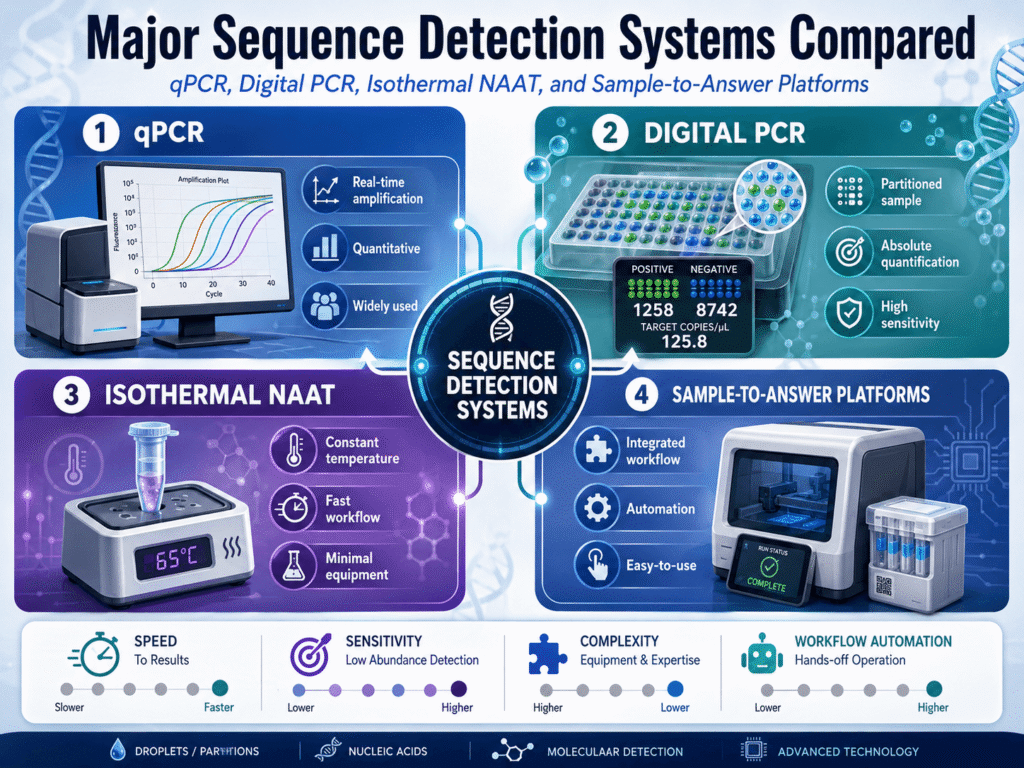
qPCR remains the familiar workhorse. Digital PCR gives more direct counting power. Isothermal NAAT supports faster and simpler amplification without full thermal cycling. Sample-to-answer systems bring extraction, amplification, detection, and analysis into one closed workflow.
The best system is not always the newest or most expensive one. It is the one that fits the sample type, target, staff skill level, reporting need, budget, and setting.
Sequence detection systems are built around different testing goals
A sequence detection system identifies or measures a DNA or RNA target. Some systems are designed for flexible research. Others are built for clinical testing, near-patient use, outbreak response, food safety, environmental testing, or high-volume screening.
The shared idea is simple.
A target sequence is copied, detected, and interpreted. The way each system does that can be very different.
qPCR follows amplification in real time using fluorescence. Digital PCR partitions the sample into many small reactions and counts positives. Isothermal NAAT amplifies nucleic acids at a steady temperature instead of cycling through heating and cooling steps. Sample-to-answer platforms wrap the full process into a cartridge, pouch, tube, or automated instrument. That difference shapes everything else.
A university core lab may care about open assay design and plate capacity. A hospital lab may care about validated menus, contamination control, and result reporting. A mobile or field lab may need a small device that runs without a full thermal cycler. A reference lab may want high-throughput automation that can handle hundreds or thousands of samples per day.
Real-time PCR and qPCR systems remain the classic sequence detection workhorse
Real-time PCR, often called qPCR, is still one of the most widely used sequence detection methods because it balances sensitivity, speed, flexibility, and cost. It detects fluorescence as amplification happens, so the instrument can estimate how much target was present at the start.
This is the category most people mean when they talk about classic “sequence detection systems.”
Applied Biosystems and Thermo Fisher qPCR systems
Applied Biosystems helped popularize the term “Sequence Detection System” through instruments such as the ABI PRISM 7700 and later ABI PRISM 7000, 7300, 7500, and 7900HT systems.
Many older papers, standard operating procedures, and lab protocols still mention these names. That is one reason legacy Applied Biosystems instruments still come up often in search results and lab conversations.
The 7500 and 7500 Fast systems became common in clinical, public health, and research settings because they offered familiar 96-well real-time PCR workflows. The 7500 Fast Dx version also played a large role in regulated testing environments.
The newer direction from Thermo Fisher is the QuantStudio family. QuantStudio 3 and 5 fit many routine qPCR labs. QuantStudio 6 and 7 Pro add more advanced software, automation-friendly features, and broader use for higher-volume workflows. QuantStudio 12K Flex serves labs that need large-scale qPCR, genotyping, or OpenArray-style testing.
For labs using older Applied Biosystems instruments, the biggest issue is not whether those systems worked well. Many did. The issue is long-term support, software age, service life, data handling, and whether the lab needs a modern platform for the next several years.
Roche LightCycler and cobas real-time PCR systems
Roche is another major name in sequence detection. The early LightCycler capillary systems were known for rapid real-time PCR in small reaction formats. The LightCycler 480 and 480 II moved that strength into plate-based workflows, including 96-well and 384-well formats.
The LightCycler 480 II is more relevant for research and applied testing labs that want a plate-based real-time PCR instrument with strong fluorescence detection and higher-throughput options.
Roche’s cobas z 480 and cobas 4800 systems sit closer to clinical molecular diagnostics. These platforms are designed around real-time PCR testing with a stronger focus on standardized sample processing, amplification, and detection in diagnostic workflows.
The difference between LightCycler and cobas is mostly the user setting. LightCycler feels like a flexible lab instrument. cobas systems are more tied to clinical assay workflows, regulated testing, and higher levels of automation.
Bio-Rad CFX and CFX Opus systems
Bio-Rad’s qPCR line has moved through several generations, including iCycler iQ, MyiQ, MiniOpticon, CFX96, CFX384, CFX96 Touch, and CFX384 Touch.
The current direction is the CFX Opus family. These systems keep the familiar Bio-Rad qPCR workflow while adding newer thermal performance, connectivity, and software support. The CFX Opus 96, 384, and Deepwell versions let labs choose between routine 96-well work, high-throughput 384-well testing, or workflows that need deeper reaction wells.
Bio-Rad systems are common in research labs because they work well for gene expression, pathogen detection, SNP genotyping, melt curve analysis, and multiplex qPCR.
A lab that already runs Bio-Rad assays or has staff trained on CFX software may find the move to CFX Opus easier than switching to a completely different vendor ecosystem.
QIAGEN Rotor-Gene Q and QIAquant systems
QIAGEN’s Rotor-Gene Q has a different design from standard block-based qPCR instruments. It uses a rotary format, which helps create uniform thermal conditions across tubes. That design has made it popular for certain qPCR, HRM, genotyping, and molecular testing workflows.
Rotor-Gene Q MDx is the clinical-facing version used in molecular diagnostic settings.
QIAGEN also offers QIAquant 96 and 384 systems. These look more like modern plate-based qPCR instruments and fit labs that want standard well formats, touchscreen operation, and 96- or 384-well throughput.
This gives QIAGEN two different qPCR paths: rotary qPCR through Rotor-Gene and plate-based qPCR through QIAquant.
Agilent, Analytik Jena, Eppendorf, Azure, Mic, and microfluidic qPCR
Agilent’s Stratagene Mx3000P, Mx3005P, and Mx4000 instruments are still seen in older publications and established research labs. AriaMx is the more modern Agilent qPCR platform.
Analytik Jena’s qTOWER and qTOWERiris systems serve research and applied testing labs that want modular real-time PCR setups.
Eppendorf’s Mastercycler realplex and Mastercycler X50 real-time PCR systems fit bench-level research workflows.
Azure Cielo 3 and Cielo 6 systems target labs that want compact qPCR instruments with three- or six-channel detection.
The Mic qPCR Cycler from Bio Molecular Systems uses magnetic induction heating in a compact format. It is popular where speed, small footprint, and portability matter.
Fluidigm, now Standard BioTools, took qPCR in a different direction with BioMark HD and microfluidic workflows. These systems are useful when the lab wants to run many sample-and-assay combinations in a smaller reaction volume.
qPCR and real-time PCR system references:
- Thermo Fisher 7500 Fast Real-Time PCR System
- Thermo Fisher StepOne and StepOnePlus Real-Time PCR Systems
- Bio-Rad CFX Opus Real-Time PCR Systems
- Roche LightCycler 480 Instrument II
Digital PCR systems count target molecules more directly
Digital PCR, or dPCR, changes the way sequence detection is measured. Instead of tracking fluorescence during exponential amplification, the sample is split into thousands of tiny reactions. Each partition is scored as positive or negative, then math is used to estimate the original target concentration.
That makes digital PCR especially useful when the lab needs absolute quantification without a standard curve.
It also helps with low-level targets, rare mutations, copy-number changes, low viral loads, wastewater testing, liquid biopsy research, gene therapy assays, and reference material measurement.
Bio-Rad QX systems
Bio-Rad is one of the best-known names in droplet digital PCR. QX100 and QX200 became widely used in research labs, with QX200 offering absolute quantification of DNA or RNA targets using EvaGreen or TaqMan probe chemistry.
QX200 workflows usually involve droplet generation, PCR amplification, droplet reading, and analysis as separate steps.
QX ONE takes that workflow closer to full automation. It integrates droplet generation, thermal cycling, droplet reading, and analysis into a more hands-free system. That can reduce manual steps and make digital PCR easier for labs that want higher consistency across users.
Bio-Rad also introduced QX600 for higher-order multiplex digital PCR, which matters when labs want to measure more targets in the same reaction.
Thermo Fisher QuantStudio digital PCR systems
Thermo Fisher first entered many digital PCR conversations through the QuantStudio 3D system. The more current focus is the QuantStudio Absolute Q Digital PCR System.
Absolute Q uses sealed-chip technology and TaqMan chemistry. Its main value is a cleaner, more contained workflow with direct quantification, rare mutation detection, and nucleic acid detection.
This type of system is useful when the lab wants digital PCR but does not want the same manual partitioning workflow seen in older droplet-based systems.
QIAGEN QIAcuity and QIAcuityDx
QIAGEN’s QIAcuity uses nanoplate-based digital PCR. Instead of droplets, the reaction is partitioned across nanowells within a plate.
One of its main strengths is workflow integration. Partitioning, thermocycling, and imaging happen within the platform, which can make digital PCR feel closer to a plate-based qPCR workflow.
QIAcuityDx extends that digital PCR approach toward diagnostic use.
For labs already using QIAGEN sample prep, PCR kits, or analysis tools, QIAcuity can fit into the broader QIAGEN ecosystem.
Roche Digital LightCycler System
The Roche Digital LightCycler System is a semi-automated digital PCR platform that partitions samples into nanowells for absolute quantification. It is built for nucleic acid target copy number measurement and supports areas such as oncology, infectious disease testing, rare mutations, copy number variation, and low target detection.
Its six fluorescence channels make it appealing for labs that need multiplex digital PCR. It also gives Roche a digital PCR option that sits beside its long-running real-time PCR and cobas systems.
Stilla naica and other digital PCR systems
Stilla’s naica system uses Crystal Digital PCR. It is known for three-color and six-color configurations, making it useful in multiplex digital PCR workflows.
Other systems, such as JN Medsys Clarity digital PCR, use chip-based partitioning. RainDance RainDrop also played a role historically in droplet digital PCR, although it is no longer a mainstream current option.
The key point is that digital PCR is not one single platform style. Droplets, chips, nanoplates, and nanowells all aim to answer the same core question: how many target molecules are present?
Digital PCR system references:
- Bio-Rad QX200 Droplet Digital PCR System
- Thermo Fisher QuantStudio Absolute Q Digital PCR System
- QIAGEN QIAcuity Digital PCR System
- Roche Digital LightCycler System
Isothermal NAAT systems remove the need for traditional thermal cycling
Isothermal NAAT systems detect nucleic acids without the repeated heating and cooling cycles used in PCR. The reaction runs at a steady temperature, which can make instruments smaller, faster, simpler, or better suited for point-of-care and field use.
This category includes LAMP, TMA, NASBA, RPA, SDA, RCA, HDA, and CRISPR-linked detection workflows.
The trade-off is that assay design, contamination control, readout method, and specificity can be more complex than the simple “no thermocycler needed” phrase suggests.
LAMP systems
Loop-mediated isothermal amplification, or LAMP, is one of the best-known isothermal methods. It can amplify DNA or RNA targets quickly at a constant temperature, often with visual, fluorescent, or turbidity-based detection.
Eiken Loopamp systems are among the best-known LAMP examples. LAMP can be read through turbidity because magnesium pyrophosphate forms as a reaction by-product. Many portable LAMP readers use fluorescence instead.
Lucira-style molecular tests brought this concept closer to home testing and near-patient use. These tests showed how molecular amplification can move outside the central lab when the chemistry, device, and result display are wrapped into a simple format.
LAMP is useful for infectious disease testing, food safety, environmental monitoring, and low-resource settings. Its weakness is that primer design can be more demanding, and false positives can happen if reaction setup and contamination control are poor.
TMA and RT-TMA systems
Transcription-mediated amplification, or TMA, is an isothermal RNA amplification method. It is used heavily in clinical molecular diagnostics.
Hologic Panther and Panther Fusion systems are the main examples in this space. Panther Fusion can run real-time PCR, TMA, and RT-TMA assays on one automated platform.
That mix matters because not every lab wants separate instruments for every chemistry. A platform that supports multiple amplification types can help a clinical lab run a broader test menu with less workflow fragmentation.
NASBA, RPA, SDA, RCA, and CRISPR-linked systems
NASBA, or nucleic acid sequence-based amplification, is another older isothermal RNA amplification method. bioMérieux NucliSENS EasyQ is a historical system often connected with NASBA-based molecular testing.
RPA, or recombinase polymerase amplification, is used in fast, portable assay development. TwistDx RPA chemistry became well known because it can amplify DNA or RNA targets at relatively low and steady temperatures, which suits point-of-care and field-style workflows.
SDA, or strand displacement amplification, appeared in older platforms such as BD ProbeTec.
RCA, or rolling circle amplification, is useful in certain probe-based or circular template workflows.
CRISPR-linked detection systems, such as SHERLOCK- and DETECTR-style assays, often pair CRISPR detection with isothermal amplification. These systems are not always commercial instruments in the same way as a qPCR machine, but they matter because they show where molecular detection can move: smaller devices, simpler readouts, and high target recognition.
Isothermal NAAT system references
- Eiken About LAMP
- Hologic Aptima Virology and TMA
- TwistDx Recombinase Polymerase Amplification
- CDC overview of nucleic acid amplification tests
Sample-to-answer platforms are built for controlled clinical workflows
Sample-to-answer systems combine multiple steps into one automated workflow. In the best-known versions, the user adds the sample to a cartridge, pouch, or instrument-specific consumable. The platform handles sample prep, nucleic acid extraction, amplification, detection, and software interpretation.
These systems are common in clinical diagnostics because they reduce manual work and help control contamination risk.
They are not always the cheapest option per test. They also may limit assay flexibility compared with open qPCR systems. Still, they are often the better choice when speed, simplicity, staff training, and standardized reporting matter more than open-ended assay design.
Cepheid GeneXpert systems
Cepheid GeneXpert is one of the clearest examples of cartridge-based molecular diagnostics. The platform automates sample extraction, PCR amplification, and detection in a closed cartridge workflow.
GeneXpert, GeneXpert Xpress, and GeneXpert Infinity cover different scales, from smaller near-patient setups to higher-throughput diagnostic workflows.
The strength of GeneXpert is simple operation with random-access testing. A lab can often run different tests as needed rather than waiting to batch a full plate. This is valuable in urgent care, hospital labs, TB testing, respiratory testing, and other situations where one patient result may be needed quickly.
BioFire FILMARRAY and TORCH
BioFire FILMARRAY takes a different approach. It is built around syndromic multiplex PCR panels. Instead of testing for one organism at a time, a panel can check a group of likely pathogens from the same specimen.
FILMARRAY integrates sample preparation, amplification, detection, and analysis in a pouch-based system. BIOFIRE TORCH expands that workflow for labs that need more capacity.
This kind of platform is useful when symptoms overlap. Respiratory infections, bloodstream infections, gastrointestinal illness, and meningitis or encephalitis can involve many possible pathogens. A multiplex panel can shorten the time from sample to result.
The trade-off is that panel testing may detect organisms that need careful clinical interpretation. A positive result is useful, but it still has to match the patient, specimen type, and disease picture.
BD MAX System
BD MAX is an automated real-time PCR molecular diagnostics system. It supports both FDA-cleared assays and open-system capabilities, which gives it a different feel from locked cartridge-only platforms.
It can run multiple sample types and assays, making it useful for labs that want automation without giving up all assay flexibility.
BD MAX fits between open qPCR instruments and fully closed sample-to-answer systems. It gives more automation than a manual extraction-plus-qPCR workflow, while still offering room for labs that run different assay types.
Roche cobas 4800, 5800, 6800, and 8800
Roche cobas systems are designed for clinical molecular testing at different scales.
cobas 4800 combines sample preparation with real-time PCR amplification and detection. cobas 5800, 6800, and 8800 move into more automated and higher-throughput molecular testing.
These systems are commonly tied to regulated diagnostic menus, viral load testing, sexually transmitted infection testing, transplant testing, and high-volume lab workflows.
For a central lab, the appeal is not just amplification. It is automation, sample tracking, software, throughput, and fewer manual touchpoints.
Abbott, Hologic, QIAGEN, Luminex, Seegene, and QuidelOrtho systems
Abbott m2000 RealTime and Alinity m are automated molecular diagnostics systems built around real-time PCR workflows. Alinity m is more integrated and fits labs that want scalable molecular testing with less manual work.
Hologic Panther and Panther Fusion support automated molecular testing with TMA, RT-TMA, and real-time PCR options. This gives clinical labs a broad platform for infectious disease testing and lab-developed workflows.
QIAGEN offers several clinical-facing systems, including QIAstat-Dx, NeuMoDx, Rotor-Gene Q MDx, and QIAcuityDx. QIAstat-Dx is closer to syndromic cartridge testing, while NeuMoDx is more aligned with automated molecular lab workflows.
Luminex and DiaSorin systems such as ARIES and Verigene have been used for cartridge-based and multiplex molecular diagnostics. xMAP-based systems also play a role in multiplex detection.
Seegene is known for multiplex real-time PCR assay ecosystems, often paired with automated extraction, liquid handling, and compatible qPCR instruments such as Bio-Rad CFX platforms.
QuidelOrtho Solana and Savanna sit closer to point-of-care or near-patient molecular testing, with isothermal or compact NAAT-style workflows.
Sample-to-answer platform references
- Cepheid GeneXpert System
- bioMérieux BIOFIRE FILMARRAY
- BD MAX System
- Hologic Panther Fusion System
- Roche cobas 5800 System
Side-by-side comparison of major sequence detection systems
Legacy systems still matter because old protocols do not disappear overnight
A modern article on sequence detection systems should not ignore older instruments. Labs still inherit methods, SOPs, validation records, and published protocols built around systems that are no longer current.
The ABI PRISM 7700 Sequence Detection System is historically important because it helped make real-time PCR a routine lab method. ABI PRISM 7000, 7300, 7500, and 7900HT systems also appear across thousands of older qPCR papers.
Roche LightCycler capillary systems shaped early real-time PCR. Cepheid SmartCycler appeared in earlier molecular testing and compatibility guides. Stratagene Mx3000 and Mx3005 instruments remain familiar to researchers who worked through the early qPCR era. Bio-Rad iCycler, MyiQ, and MiniOpticon systems filled the same role before the CFX line became more common.
Legacy systems matter for three reasons:
They help readers understand older papers. They explain why some labs still mention “sequence detection system” instead of simply saying qPCR machine. They also help labs plan instrument replacement without losing continuity with older data.
A lab moving from ABI 7500 to QuantStudio, from CFX96 Touch to CFX Opus, or from older LightCycler systems to newer Roche platforms has to think about assay transfer, software differences, calibration, dye channels, validation, and staff retraining.
Choosing between qPCR, digital PCR, isothermal NAAT, and sample-to-answer systems
The right system depends on the result the lab needs.
qPCR is often the best starting point when the lab needs flexible detection or relative quantification. It works well for gene expression, pathogen detection, melt analysis, genotyping, and many routine molecular workflows.
Digital PCR fits when the lab needs more precise target counting, especially at low levels. It is the stronger choice for rare allele detection, copy-number measurement, low viral targets, reference standards, and cases where standard curves create too much uncertainty.
Isothermal NAAT fits when speed, portability, and simpler heating matter. It is a strong option for point-of-care design, field testing, rapid screening, and settings where a full thermal cycler is not practical.
Sample-to-answer platforms fit when the lab needs less manual work and more standardized testing. These systems are especially useful when staff time is limited, contamination control is a concern, or fast clinical reporting is more valuable than assay flexibility.
The mistake is treating all sequence detection systems as interchangeable. A 384-well qPCR platform and a GeneXpert cartridge system may both detect nucleic acids, but they solve different problems. One favors batch flexibility and assay control. The other favors speed, simplicity, and closed-cartridge testing.
Throughput, multiplexing, and automation change the real cost
Instrument price matters, but it is not the whole cost.
A low-cost qPCR instrument may become expensive if staff spend too much time on extraction, plate setup, troubleshooting, and manual reporting. A sample-to-answer platform may have a higher cost per test but save labor and reduce repeat testing. A digital PCR system may cost more per run but answer questions that qPCR cannot answer as cleanly.
Throughput also changes the decision.
A 96-well qPCR system may be enough for a small lab. A 384-well system may make more sense for a core facility. A cartridge platform may be ideal for urgent single samples. A high-throughput cobas or Panther setup may be better for a central lab running large daily volumes.
Multiplexing adds another layer.
qPCR instruments with more detection channels can test multiple targets in one reaction, but assay design becomes harder as more targets are added. Digital PCR multiplexing can separate signals with partitions and fluorescence channels, but it still requires careful assay setup. Syndromic sample-to-answer panels offer broad multiplex testing, yet the lab often works within the vendor’s panel design.
Automation is not just convenience. It changes staffing, error rates, contamination risk, turnaround time, and how confidently the lab can scale.
The future of sequence detection is moving toward faster, smaller, and more connected systems
Sequence detection is moving in several clear directions.
- Instruments are becoming easier to operate. Touchscreens, cloud-connected software, guided setup, and better result review are now part of many new systems.
- Workflows are becoming more closed and automated. Clinical labs want fewer open-tube steps because contamination, staff time, and training burden all affect results.
- Digital PCR is becoming more practical. Older workflows required several separate steps. Newer systems are making partitioning, amplification, imaging, and analysis feel less fragmented.
- point-of-care molecular testing is becoming more realistic. Isothermal chemistry, small readers, disposable cartridges, and home molecular tests have shown that nucleic acid detection does not always need a central lab.
- Software is becoming part of the system, not an afterthought. Data review, threshold setting, quality control, audit trails, remote access, and lab information system connections can now shape buying decisions as much as optics or thermal blocks.
The best sequence detection system will not be the same for every lab. qPCR will remain the broad workhorse. Digital PCR will keep growing where exact counting and rare target detection matter. Isothermal NAAT will keep pushing molecular testing into smaller and faster formats. Sample-to-answer platforms will keep gaining ground in clinical settings where speed and simplicity carry real value.
The smartest choice starts with the sample, the target, and the decision that depends on the result. Once those are clear, the right platform becomes much easier to see.