How Do You Choose the Right Sequence Detection System for a Lab?
Choosing the right sequence detection system starts with one honest question: what decision will this result help your lab make? A small research lab tracking gene expression does not need the same setup as a hospital lab running infectious disease assays, a cancer center doing mutation profiling, or a genomics core handling high-throughput sequencing.
The right system should match your sample volume, target type, sensitivity needs, staff skill, budget, compliance burden, and reporting timeline. In practical terms, most labs choose between real-time PCR, digital PCR, Sanger sequencing, or next-generation sequencing. Each one answers a different kind of question. A smart choice is not always the newest machine. It is the system that gives accurate, repeatable, defensible results without slowing the lab down or draining the budget.
What is a sequence detection system in a lab?
A sequence detection system is a lab platform that detects, measures, or reads specific DNA or RNA sequences from biological samples. In daily lab language, this can mean a real-time PCR instrument, a digital PCR platform, a Sanger sequencer, or an NGS system.
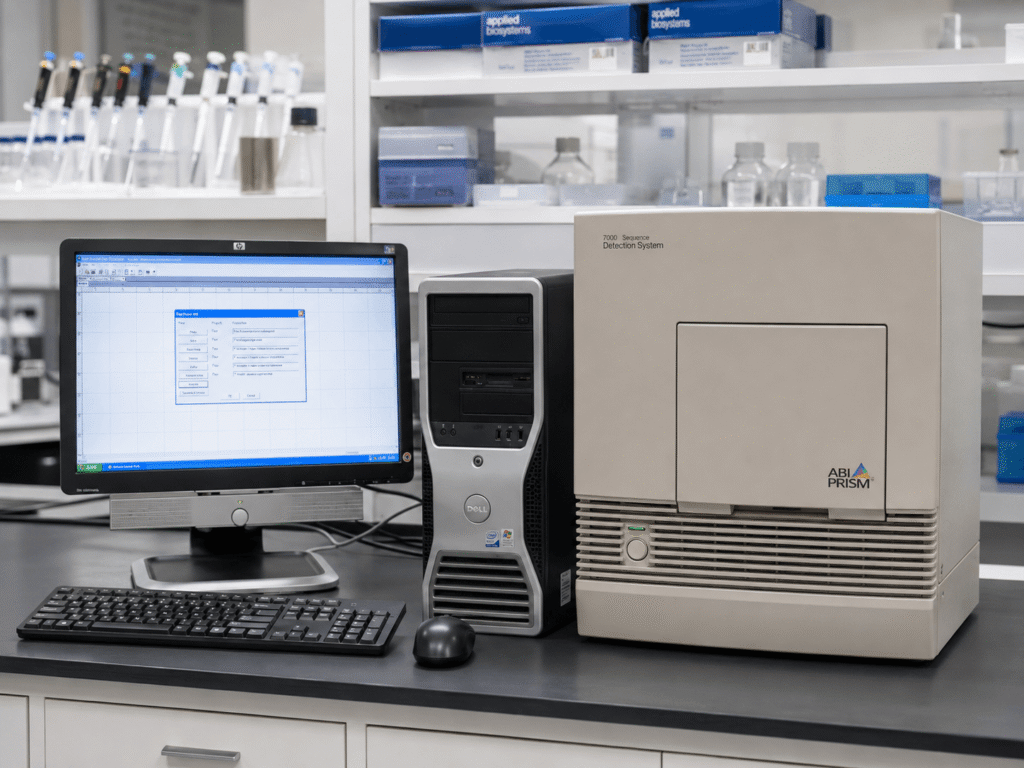
The term is often linked with real-time PCR because older Applied Biosystems instruments used “Sequence Detection System” language for fluorescence-based nucleic acid detection. Today, labs use the phrase more broadly when comparing molecular platforms for gene expression, pathogen detection, mutation testing, genotyping, copy number analysis, and sequencing workflows.
A real-time PCR system tracks amplification as it happens through fluorescent signals. Many Applied Biosystems real-time PCR instruments come in 96-well and 384-well formats, with options for multiplexing, remote monitoring, onboard memory, and fast run times on selected models.
Digital PCR takes a different route. It partitions the sample and counts positive and negative reactions, giving absolute target measurement without standard curves. Droplet digital PCR works by separating a sample into thousands of droplets, then counting which droplets show fluorescence and which do not. That count is then used to calculate the target amount with Poisson statistics.
NGS goes further by reading many DNA or RNA fragments in parallel. NGS reads many DNA or RNA fragments in parallel, which allows labs to study large genetic regions, multiple genes, or many variants in a single workflow.
What should a lab decide before comparing instruments?
A lab should decide the test purpose, sample volume, target complexity, turnaround time, reporting needs, and quality requirements before comparing instruments. Without that groundwork, the buying process turns into a spec-sheet contest, and spec sheets rarely tell the whole story.
Start with the question your lab needs to answer.
If the question is, “Is this pathogen present?” real-time PCR may be enough. If the question is, “How many copies are present at very low abundance?” digital PCR may fit better. If the question is, “Which variant is present in this gene?” Sanger or targeted NGS may be needed. If the question is, “What is happening across hundreds of genes?” NGS becomes more realistic.
The second decision is sample volume. A 96-well qPCR system can be perfect for a low-to-medium-volume lab. A 384-well system may suit a core lab or screening group. PCR and qPCR plates are commonly available in 48-well, 96-well, and 384-well formats. Higher well counts help labs run more samples in one batch, which matters when testing volume grows.
The third decision is how fast results must be returned. A clinical infectious disease lab may need same-day answers. A research lab studying expression trends may tolerate longer runs. A sequencing core may care more about batching efficiency than single-sample speed.
Is real-time PCR the right choice for routine sequence detection?
Real-time PCR is usually the right choice when a lab needs fast, targeted, repeatable detection of known DNA or RNA sequences. It is best for defined targets, routine assays, moderate budgets, and workflows where staff already understand PCR.
This makes qPCR a strong fit for pathogen detection, gene expression studies, SNP genotyping, copy number checks, and residual DNA testing. It is also easier to adopt than NGS because the workflow is familiar to many labs.
The main strength is speed. Some real-time PCR systems, such as QuantStudio models, can support 96 or 384 reactions per run, multiplex assays, and shorter run times depending on the selected configuration.
The tradeoff is scope. qPCR is excellent when you already know what you are looking for. It is weaker when you need to find unknown variants, scan many genes, or characterize complex samples.
A lab should choose qPCR when the test menu is targeted, the expected targets are known, and the team needs reliable throughput without a heavy bioinformatics burden.
When does digital PCR make more sense than qPCR?
Digital PCR makes more sense when the lab needs very precise measurement, low-level variant detection, copy number work, viral load analysis, or absolute target counts without standard curves. It is often chosen when small differences matter.
The emotional side of this decision is real. Many labs move to digital PCR after living with borderline Ct values, weak standard curves, or repeat testing that eats staff time. Digital PCR can reduce that uncertainty in the right use case.
ddPCR provides absolute target counts without standard curves and is suited for target DNA measurement, viral load analysis, and microbial measurement. Droplet digital PCR has also been widely studied as a precise method for absolute nucleic acid measurement, especially when small concentration differences matter.
That does not mean digital PCR should replace qPCR everywhere. It can cost more per sample, may need more workflow steps, and may not be ideal for broad screening. It shines when accuracy at low abundance is worth the extra cost.
Choose digital PCR when the lab’s pain point is not detecting common positives, but measuring rare or low-copy targets with confidence.
When should a lab choose NGS instead of PCR-based systems?
A lab should choose NGS when it needs to examine many genes, many variants, many organisms, or complex sequence patterns in one workflow. NGS is best when the question is too broad for single-target PCR.
Cancer panels, inherited disease testing, microbial genomics, metagenomics, outbreak tracking, and large research studies often point toward NGS. The reason is simple: PCR asks a narrow question. NGS can ask hundreds or thousands of questions in one run. Because NGS uses massively parallel sequencing, it can answer broader genetic questions than single-target PCR methods. CAP’s 2025 checklist summary lists NGS across inherited disease, oncology, infectious disease, and noninvasive fetal chromosomal screening areas.
The tradeoff is complexity. NGS needs library preparation, controls, sequencing chemistry, data storage, analysis pipelines, variant review, and trained staff. A lab that buys an NGS instrument without planning bioinformatics often ends up with a beautiful machine and a reporting bottleneck.
NGS is the right choice when the clinical or research question demands breadth and when the lab can support the full workflow after the run ends.
How much sample volume should shape the buying decision?
Sample volume should shape instrument format, automation needs, staffing, reagent costs, and batching strategy. A system that looks affordable at 20 samples per week may become expensive and slow at 300 samples per day.
Low-volume labs should be careful about buying oversized platforms. Reagents may expire before use. Controls may consume a high share of each run. Staff may struggle to keep skills sharp if the assay is rarely performed.
Medium-volume labs usually benefit from 96-well systems because they balance cost, throughput, and workflow simplicity. High-volume labs may need 384-well qPCR, liquid handling, automated extraction, plate tracking, or LIMS connection.
For qPCR, plate format matters because 48-well, 96-well, and 384-well plates directly affect how many samples can be tested in a run. Higher-well plate formats allow more samples to be analyzed in one run and can fit better with automated workflows.
The best rule is to calculate total weekly testing, not just today’s run size. Include repeats, controls, failed extractions, staff shifts, maintenance time, and seasonal surges. A respiratory lab, for example, may look quiet in July and overwhelmed in January.
How should a lab compare sensitivity, specificity, and precision?
A lab should compare sensitivity, specificity, and precision by matching instrument claims with the assay’s real sample type, extraction method, target concentration, and reporting threshold. Vendor data helps, but local performance data matters more.
Analytical sensitivity asks how little target the test can detect. Analytical specificity asks whether the assay avoids false signals from related organisms, nearby variants, or nonspecific amplification. Precision asks whether the same sample gives the same answer across runs, operators, instruments, reagent lots, and days.
For molecular assays, performance work often includes accuracy, precision, reportable range, reference interval, analytical sensitivity, and analytical specificity. Burd’s widely cited review on laboratory-developed molecular assays lists these performance characteristics as part of molecular assay performance studies.
For quantitative tests, labs also need to check limit of detection, linearity, reportable range, and precision before results can be trusted in routine use.
A lab should not ask only, “What is the lowest copy number this system can detect?” A better question is, “Can it detect the target at the level where our result changes a patient, product, or research decision?”
What role do controls and standards play?
Controls and standards tell the lab whether the system, assay, extraction, amplification, and analysis are behaving as expected. Without them, a sequence detection result is just a signal, not a trustworthy answer.
Every platform needs controls. Negative controls check contamination. Positive controls check reagent and amplification performance. Internal controls check inhibition or extraction failure. Quantitative assays may need standards, reference material, or calibrators.
MIQE guidelines were created to improve how qPCR experiments are reported, especially when readers need enough detail to judge quality, repeatability, and assay setup. MIQE reporting covers the core details needed to review a qPCR experiment properly, from assay design to data analysis and quality checks.
For labs publishing data, MIQE-style thinking is good practice. For clinical labs, it is part of responsible testing. If a system makes it hard to track controls, review amplification plots, export raw data, or document run quality, that weakness will show up during audits and troubleshooting.
Good controls cost money. Poor controls cost more.
How much should software and data handling matter?
Software and data handling should matter as much as optics, wells, and chemistry. A system that produces strong signals but poor records can create reporting errors, audit stress, and staff frustration.
For qPCR, software should support baseline review, threshold settings, melt curve analysis if needed, plate setup, user permissions, audit trails, and exportable reports. Some Applied Biosystems QuantStudio systems list software features for 21 CFR Part 11 compliance support, which may matter for regulated labs.
For NGS, software is even more central. Data must move from sequencer to analysis pipeline, then to variant review, interpretation, reporting, and storage. Labs need version control, audit trails, reference genome documentation, variant database policies, and cybersecurity planning.
A buyer should ask vendors direct questions:
- Can raw data be exported?
- Can user actions be tracked?
- Can old runs be reanalyzed?
- Can the system connect with LIMS?
- Who owns the data?
- What happens if the cloud service is unavailable?
- How long are software versions supported?
The instrument may sit on a bench, but the data lives much longer than the run.
What should clinical labs check for compliance?
Clinical labs should check whether the system fits CLIA, CAP, ISO 15189, local regulations, documentation rules, staff competency needs, and intended-use limits. A system can be technically strong but still wrong for a regulated workflow.
ISO 15189:2022 specifies requirements for quality and competence in medical laboratories and applies to medical laboratories, accreditation bodies, regulatory authorities, and point-of-care testing.
CAP’s 2025 checklist summary includes molecular assay performance work, PCR, sequencing, and NGS-related areas. CMS guidance on CLIA verification discusses performance specifications such as accuracy, precision, reportable range, and reference intervals for laboratory testing.
In the USA, LDT regulation has also changed recently. FDA states that after a federal district court vacated the 2024 LDT final rule, FDA issued a 2025 final rule reverting to the regulation text that existed before the May 2024 rule.
This matters because a lab buying a sequence detection system for clinical use should not rely on yesterday’s regulatory assumptions. The compliance path can affect assay design, documentation, claims, reporting language, and vendor selection.
How should research labs make the choice differently?
Research labs should focus on flexibility, assay development freedom, reagent access, exportable raw data, publication standards, and long-term method adaptability. Unlike clinical labs, research labs often need room to test new targets and revise protocols.
A research lab may prefer an open qPCR system that supports multiple dye chemistries, flexible cycling programs, and easy data export. A translational genomics lab may prefer NGS even at lower sample volume because future projects will need broader data. A gene therapy group may need digital PCR for copy number, vector titer, or low-level target measurement.
Publication quality also matters. MIQE guidelines are still widely cited for qPCR reporting, with the original paper now carrying very high citation counts in PubMed.
Research labs should not buy only for the current grant. They should buy for the next three years of questions. The best system is flexible enough to support new assays without forcing the team into constant workaround mode.
What questions should you ask vendors before buying?
A lab should ask vendors about real performance, reagent supply, service response, software lifespan, instrument downtime, training, documentation, and total cost. The sales demo should feel less like a showroom and more like a stress test.
Ask for data from sample types close to yours. If you test FFPE tissue, nasal swabs, wastewater, plasma, food samples, or low-biomass specimens, generic DNA data may not help much.
Ask about service. A low-cost system becomes expensive if it sits idle for two weeks during a failure. Ask where engineers are based, how fast parts ship, whether preventive maintenance is required, and what is included in the service contract.
Ask about consumables. Some systems lock you into proprietary plastics, cartridges, chips, reagents, or cloud software. That may be fine if the workflow is strong, but the lifetime cost should be visible before purchase.
Ask about training. Staff turnover is real. A system that only one senior scientist can run is a risk.
How do you calculate the real cost of a sequence detection system?
The real cost includes purchase price, service contracts, reagents, consumables, controls, calibrators, extraction kits, software, data storage, staff time, training, failed runs, quality studies, and downtime. The sticker price is only the first line.
For qPCR, cost drivers include plates, seals, master mix, probes, primers, controls, extraction reagents, calibration, and maintenance. For digital PCR, include partitioning consumables, readers, droplet or chip supplies, and per-sample reagent cost. For NGS, include library prep kits, indexes, flow cells, QC assays, storage, analysis software, and interpretation labor.
A practical buying model should include:
- Cost per reportable result, not cost per reaction
- Expected repeat rate
- Number of controls per run
- Staff hands-on time
- Service and maintenance
- Reagent waste from batching
- Training time for new staff
- Data storage and analysis fees
This is where many labs get surprised. A cheaper instrument can cost more over five years if consumables are high, runs fail often, or service is weak.
How should labs think about maintenance and uptime?
Labs should treat maintenance and uptime as core selection criteria because molecular testing depends on consistency. Temperature accuracy, optical performance, calibration, software stability, and clean workflows all affect results.
WHO’s Laboratory Quality Management System handbook covers equipment selection and acquisition as part of lab quality management, and it is based on ISO 15189 and CLSI GP26-A3 documents. Africa CDC also states that sound equipment management helps maintain accurate, reliable, timely testing, lowers repair costs, lengthens instrument life, and supports accreditation.
Before buying, ask for the maintenance schedule. Ask what users can handle and what requires an engineer. Ask whether calibration tools are included. Ask how the instrument flags optical or thermal problems.
A lab that runs patient samples cannot build its plan around hope. It needs backup pathways, service coverage, spare parts access, and written downtime procedures.
What mistakes do labs make when choosing a sequence detection system?
Labs often choose the wrong system when they buy for prestige, focus only on price, ignore workflow, underestimate data needs, or fail to involve the people who will run the instrument every day.
One common mistake is buying NGS when qPCR would answer the question faster and cheaper. Another is buying qPCR when the test menu clearly needs broader variant detection. A third is choosing a closed system without checking reagent supply or long-term software support.
Labs also underestimate pre-analytical steps. Extraction quality, sample transport, inhibition, storage, and contamination control can matter as much as the detector. WHO’s lab quality materials stress sample tracking, sample transport, storage, and disposal as part of reliable lab work.
The quietest mistake is ignoring staff experience. If a system adds too many manual steps, unclear software screens, or fragile consumables, errors rise. The best platform should fit the people as well as the science.
What is the best sequence detection system for a small lab?
The best sequence detection system for a small lab is often a reliable 96-well real-time PCR platform if the lab performs targeted testing. It gives a strong balance of cost, speed, ease of use, and assay flexibility.
A small lab should choose digital PCR only when low-copy precision or absolute measurement justifies the added cost. It should choose NGS only when broad sequence data is truly needed and the lab has a plan for data analysis, quality work, and staffing.
For many small labs, the smartest setup is not one large platform. It may be a qPCR system in-house, with complex sequencing outsourced until volume grows. This keeps capital spending under control while still allowing access to advanced testing.
A small lab should ask, “What can we run well every week?” not “What looks most advanced?”
What is the best sequence detection system for a high-throughput lab?
The best system for a high-throughput lab is one that supports batching, automation, fast data review, LIMS connection, strong service coverage, and high run capacity. Throughput is not just wells or reads. It is the number of clean, reportable results produced per shift.
High-throughput qPCR labs may need 384-well blocks, liquid handlers, barcode tracking, automated extraction, and plate-based reporting. High-throughput sequencing labs may need large sequencers, robotics, sample tracking, variant review teams, and storage planning.
Illumina’s smaller MiSeq i100 systems were announced for benchtop sequencing, with global shipping planned from 2025, while larger NovaSeq X systems serve deeper sequencing needs; Reuters reported U.S. list prices of $49,000 for MiSeq i100, $109,000 for i100 Plus, and just under $1 million for NovaSeq X.
That price spread shows why volume planning matters. A high-throughput lab can justify expensive systems when sample volume, reimbursement, research funding, or core facility demand supports them. A lower-volume lab may not.
How do you make the final decision?
The final decision should come from a weighted scorecard based on test purpose, sample volume, sensitivity needs, workflow fit, software, compliance, service, cost per result, and growth plans. The highest-scoring system should also pass a real-world demonstration using your sample type.
Run your top two choices through this scorecard. Then ask vendors for a demo with your sample type or a closely matched workflow. Watch how staff interact with the system. Review the data output. Check how easy it is to spot failed controls, export files, and document the run.
The right choice usually becomes clear when the system is tested against daily lab reality.
| Selection factor | Why it matters |
| Test purpose | Keeps the lab from buying more or less technology than needed |
| Sample volume | Matches wells, batching, automation, and staffing |
| Sensitivity needs | Guides qPCR vs digital PCR vs sequencing |
| Target complexity | Determines whether targeted detection or broad sequencing is needed |
| Software and records | Protects reporting, audits, and data review |
| Compliance fit | Supports CLIA, CAP, ISO, or local requirements |
| Service support | Reduces downtime risk |
| Cost per result | Shows the real five-year cost |
| Staff fit | Lowers training burden and user errors |
| Growth room | Keeps the system useful as the test menu expands |
The right system is the one your lab can trust on a hard day
A sequence detection system should not be chosen because it sounds advanced. It should be chosen because it answers your lab’s questions with accuracy, speed, and repeatability that your team can defend.
For targeted, routine work, real-time PCR is often the most practical choice. For low-copy precision and absolute measurement, digital PCR may be the better fit. For broad variant discovery, complex panels, or large genetic questions, NGS earns its place. Sanger still has value for focused sequence confirmation when throughput is modest.
A lab that chooses well starts with the result it needs, studies the full workflow, checks the data path, plans quality work, and looks at five-year cost instead of day-one price. That kind of decision does more than buy an instrument. It protects the people waiting for the result.