DNA Replication Enzymes: How They Work and What They Do
DNA replication may sound straightforward: before a cell divides, it must make a copy of its DNA. Inside the cell, however, this process depends on a tightly organized group of enzymes and helper proteins. Helicase opens the double helix. Topoisomerase relieves twisting ahead of the replication fork. Primase creates a starting point. DNA polymerases build the new strands, while other proteins hold the machinery in place, remove primers, proofread mistakes, and seal the final gaps.
DNA replication enzymes work like a relay team rather than independent workers. Each one handles a specific problem created by copying a long, double-stranded molecule whose two strands run in opposite directions. Their combined activity allows DNA to be copied quickly and with very high accuracy before a cell divides.
What are DNA replication enzymes?
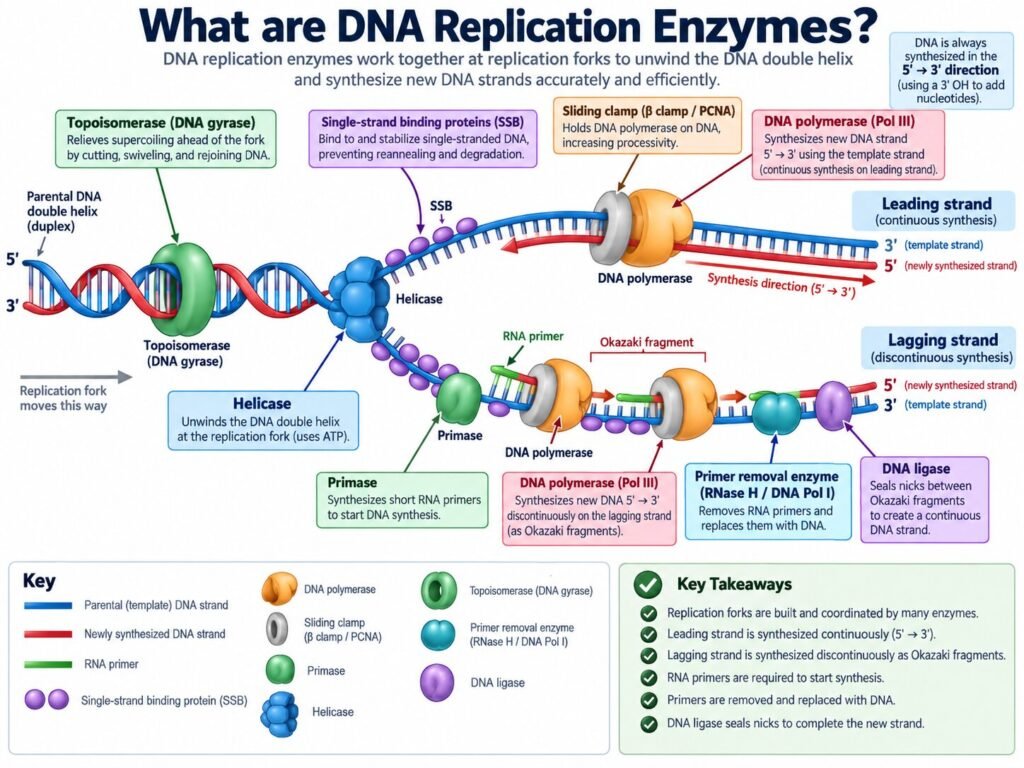
DNA replication enzymes are proteins that carry out the chemical steps needed to copy DNA. Some unwind or cut DNA, some build nucleic acid chains, and others remove primers or join DNA fragments after synthesis.
Not every protein at a replication fork is technically an enzyme. Single-strand binding proteins, RPA, sliding clamps, and several structural proteins do not catalyze the same kind of chemical reaction, yet replication would be far less efficient without them. For that reason, a useful explanation of DNA replication needs to include both the enzymes and the key accessory proteins that work beside them.
Replication begins at specific regions called origins of replication. From each active origin, the DNA opens into a replication bubble with a replication fork at either end. The proteins gathered at a fork form a larger working unit called the replisome.
Why does DNA replication need so many enzymes?
DNA cannot be copied by one enzyme because several physical and chemical problems have to be solved at the same time. The helix must open, the exposed strands must remain apart, DNA tension must be controlled, and a polymerase must have a primer before it can begin adding nucleotides.
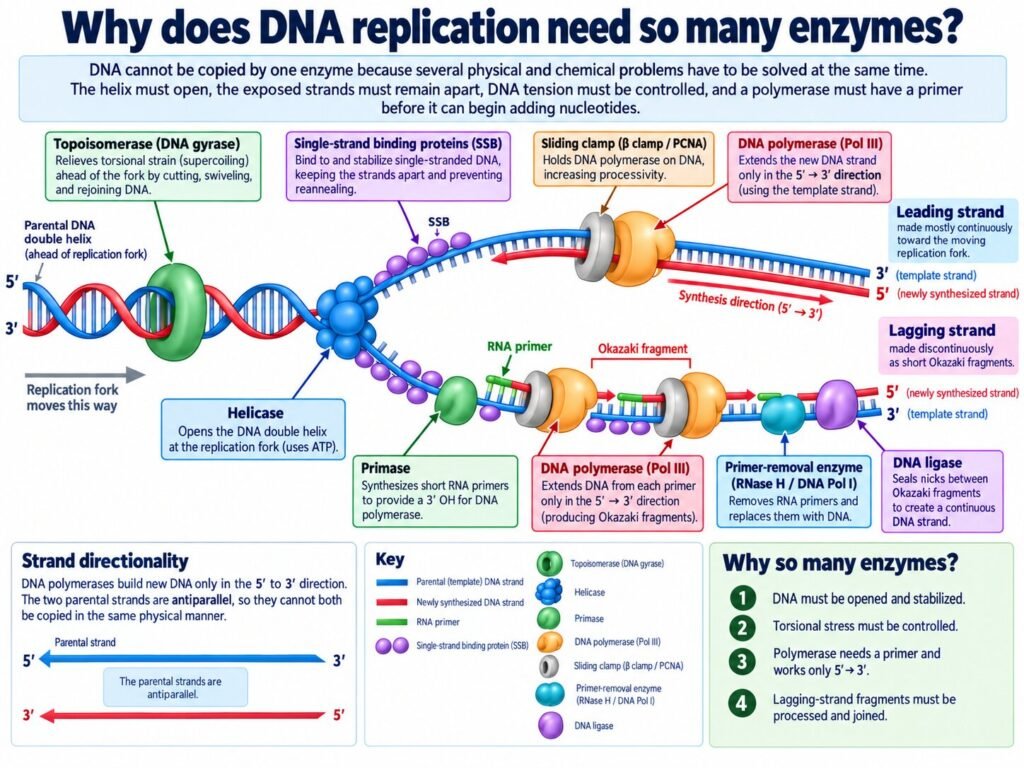
There is another complication: DNA polymerases build new DNA only in the 5′ to 3′ direction. The two parental strands are antiparallel, so they cannot both be copied in the same physical manner.
One new strand, called the leading strand, is made mostly continuously toward the moving replication fork. The other, called the lagging strand, is made discontinuously as short Okazaki fragments. That difference is why primase, primer-removal enzymes, and DNA ligase are especially busy on the lagging strand.
Main DNA replication enzymes and proteins
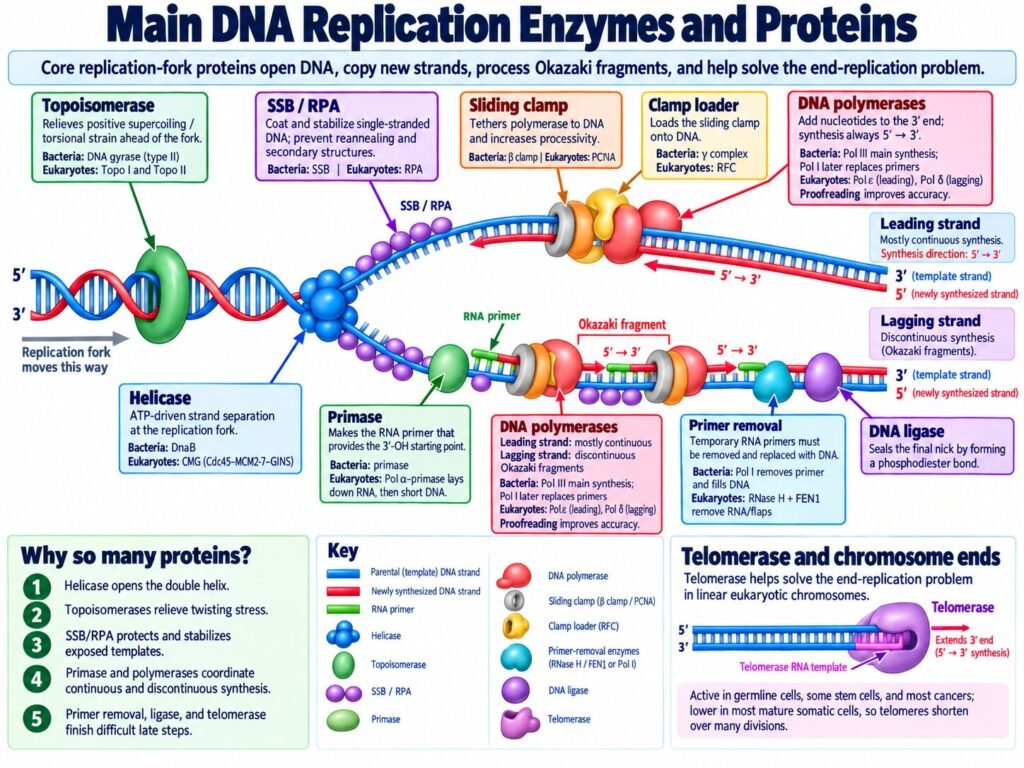
The exact names differ between bacteria and eukaryotes, but the core jobs are strikingly similar. The following proteins handle the major tasks of opening DNA, copying it, processing the new strands, and keeping the replication fork moving.
Helicase opens the DNA double helix
Helicase separates the two parental DNA strands at the replication fork. It uses energy from ATP to move along DNA and disrupt the hydrogen-bonded base pairing that holds the two strands together.
Once helicase begins unwinding DNA, a Y-shaped replication fork forms. The exposed strands can then serve as templates for new DNA synthesis.
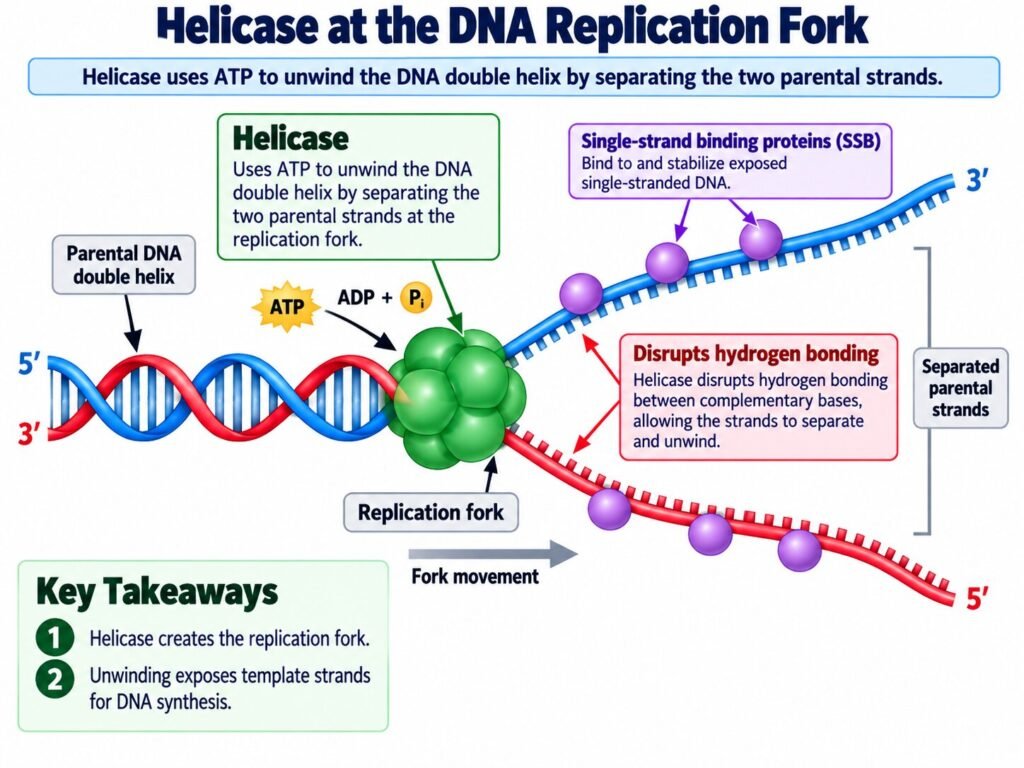
In bacteria such as Escherichia coli, the main replicative helicase is DnaB. In eukaryotic cells, the replicative helicase is the CMG complex, named for its three main parts: Cdc45, MCM2-7, and GINS. CMG travels with the eukaryotic replisome and is closely connected with leading-strand synthesis.
Helicase does not work comfortably in isolation. As it opens more DNA, torsional strain builds ahead of the fork, while the exposed single strands behind it become prone to pairing with themselves or each other. Topoisomerases and single-strand binding proteins solve those problems.
Topoisomerase relieves twisting ahead of the fork
Topoisomerases control the extra twisting created when helicase unwinds DNA. They temporarily break DNA, allow the molecule to relax or pass through itself, and then reseal the backbone.
Without this activity, positive supercoiling would build in front of the advancing replication fork and make continued unwinding increasingly difficult.
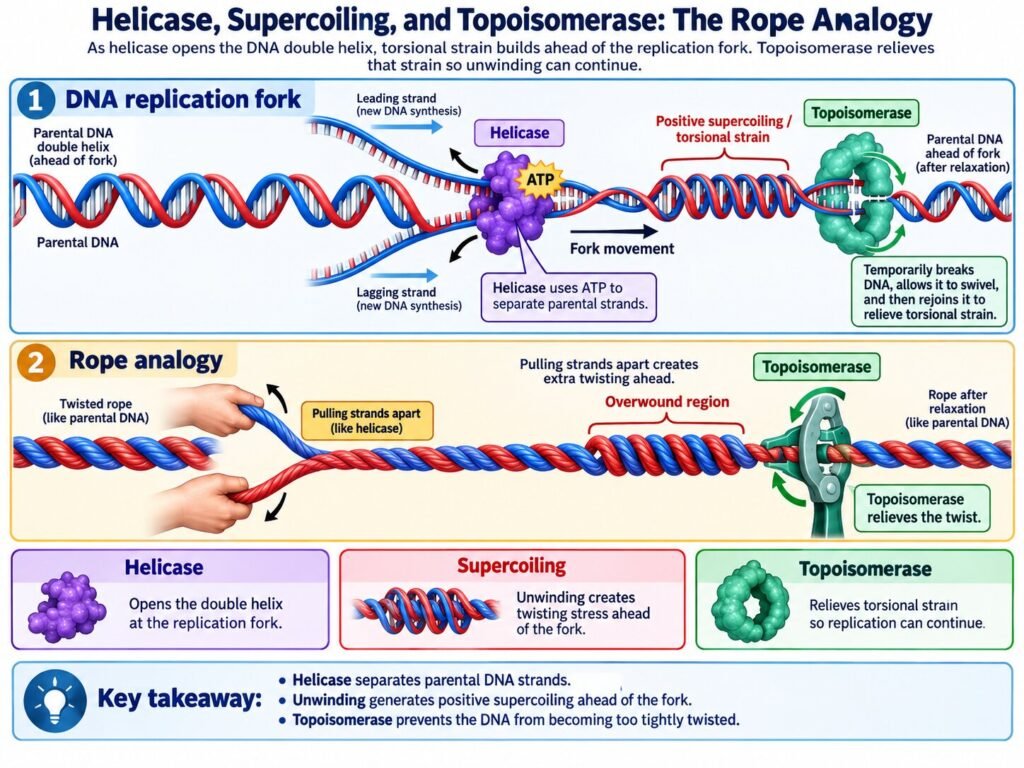
Bacteria use DNA gyrase, a type II topoisomerase, to help control supercoiling. Other topoisomerases also help separate DNA molecules that become linked during replication. Eukaryotic cells use type I and type II topoisomerases for related mechanical problems.
This role is easy to picture with a twisted rope. Pull two strands apart at one point and the section farther ahead becomes more tightly wound. Helicase creates that kind of stress in DNA, and topoisomerases release it.
Single-strand binding proteins keep the templates open
Once helicase separates the parental strands, single-strand binding proteins attach to the exposed DNA. Their job is to keep the strands stable and stop them from pairing back together before they can be copied.
Bacteria use SSB proteins. Eukaryotes use replication protein A, usually shortened to RPA.
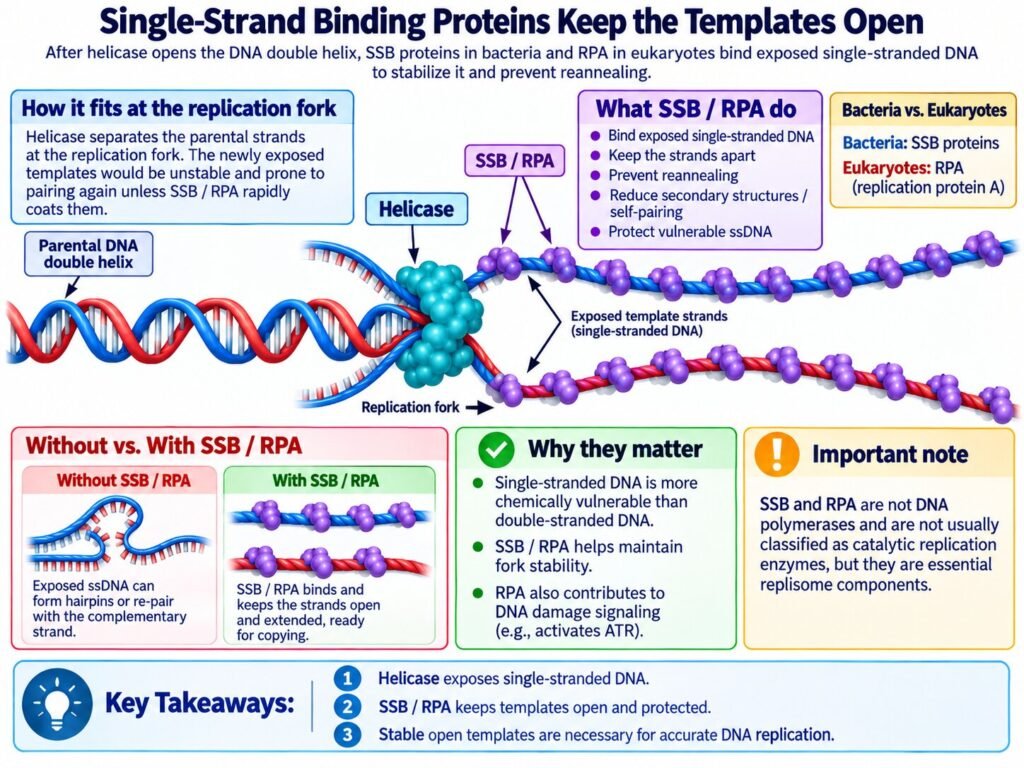
These proteins also protect exposed single-stranded DNA, which is more chemically vulnerable than double-stranded DNA. RPA has additional roles in DNA damage signaling and fork stability, making it more than a passive coating.
SSB and RPA are not polymerases and are not usually classed as catalytic replication enzymes. Still, they are core replisome components because open DNA templates would otherwise be difficult to manage.
Primase creates the starting point for DNA synthesis
DNA polymerases cannot begin a new strand from scratch because they need an existing 3′-OH end. Primase creates the short RNA primer that provides this starting point for DNA synthesis.
In bacteria, primase makes a short RNA primer. DNA polymerase can then extend from that primer.
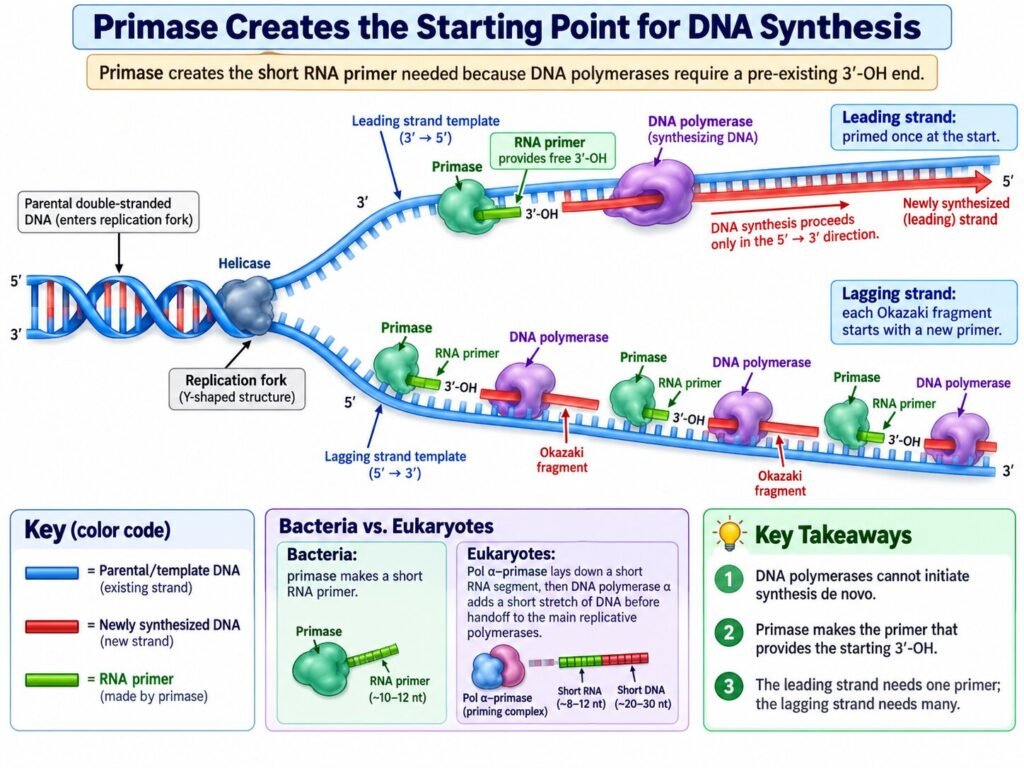
Eukaryotes use the Pol α-primase complex. Its primase activity lays down a short RNA segment, and DNA polymerase alpha then adds a short stretch of DNA. The primer is later handed to the main replicative polymerases.
The leading strand needs priming at the start of synthesis, while the lagging strand needs repeated priming because every Okazaki fragment starts separately.
DNA polymerases build the new DNA strands
DNA polymerases are the main DNA-building enzymes. They read the parental template and add complementary deoxyribonucleotides to the growing daughter strand.
New DNA is always extended in the 5′ to 3′ direction. The incoming nucleotide is added to the 3′ end of the growing chain, creating a phosphodiester bond in the sugar-phosphate backbone.
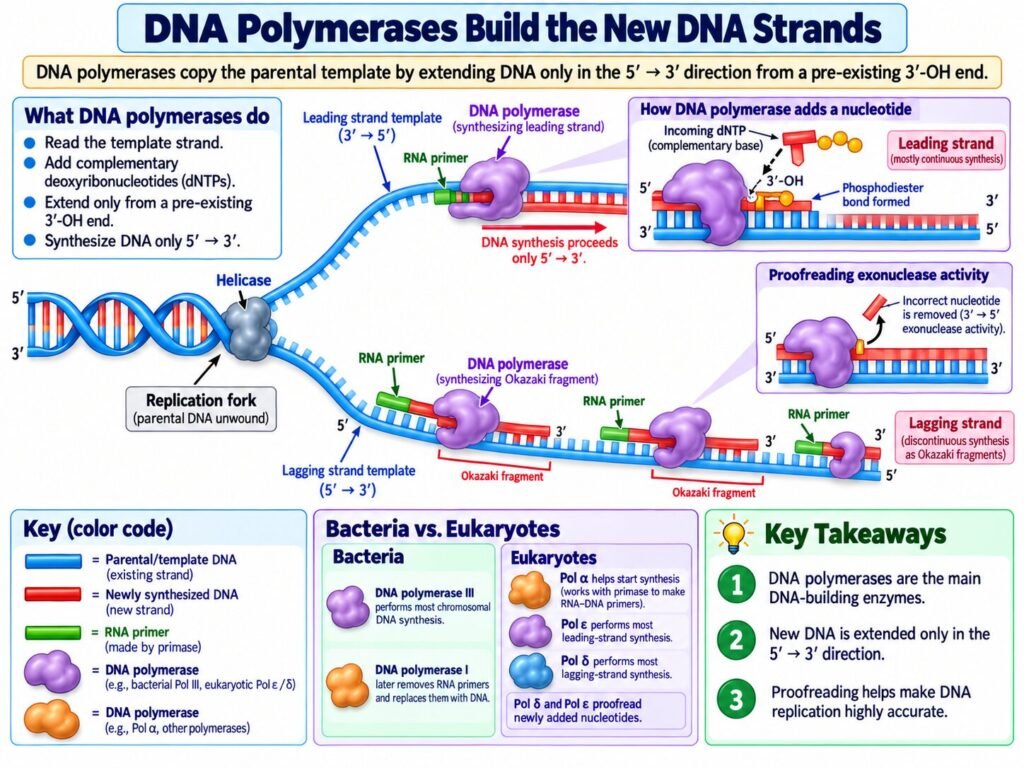
In E. coli, DNA polymerase III performs most chromosomal DNA synthesis. DNA polymerase I has an important later role in removing RNA primers and replacing them with DNA.
Eukaryotic replication uses a division of labor among several polymerases. Pol α helps start synthesis. Pol ε performs most leading-strand synthesis under normal replication conditions, while Pol δ performs most lagging-strand synthesis. Pol δ and Pol ε also carry proofreading exonuclease activity that can remove many incorrectly inserted nucleotides.
That proofreading ability helps explain why DNA copying is so accurate. Base selection, proofreading, and post-replication mismatch repair together can reduce the final error frequency to roughly one mistake per 10^9 to 10^10 nucleotides copied.
Sliding clamps keep polymerases attached to DNA
A DNA polymerase would be much less productive if it repeatedly fell off the template after adding only a few nucleotides. Ring-shaped sliding clamps solve that problem by surrounding DNA and tethering the polymerase close to its template.
Bacteria use a beta sliding clamp, while eukaryotic cells use PCNA to help keep DNA polymerases associated with the template during replication.
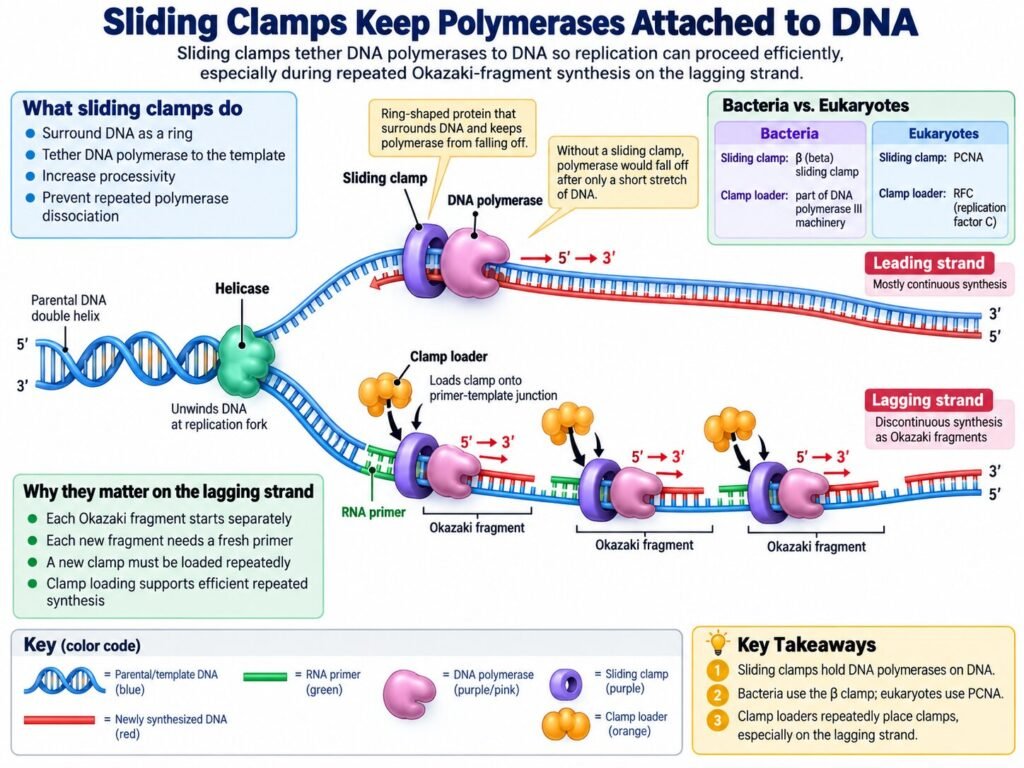
Sliding clamps are loaded onto DNA by clamp-loader complexes. In bacteria, the clamp loader is part of the DNA polymerase III machinery. In eukaryotes, RFC, or replication factor C, loads PCNA onto primer-template junctions.
This setup is especially useful on the lagging strand. Each new Okazaki fragment needs a fresh primer and a newly positioned polymerase complex, so clamps and clamp loaders support repeated cycles of DNA synthesis.
RNase H and FEN1 help remove eukaryotic primers
RNA primers are temporary. Once an Okazaki fragment has been extended, the primer at its beginning must be removed and the region replaced with DNA.
In eukaryotic cells, RNase H enzymes remove much of the RNA found in RNA-DNA hybrids. FEN1, or flap endonuclease 1, cuts displaced flap structures that arise as Pol δ processes the boundary between neighboring Okazaki fragments.
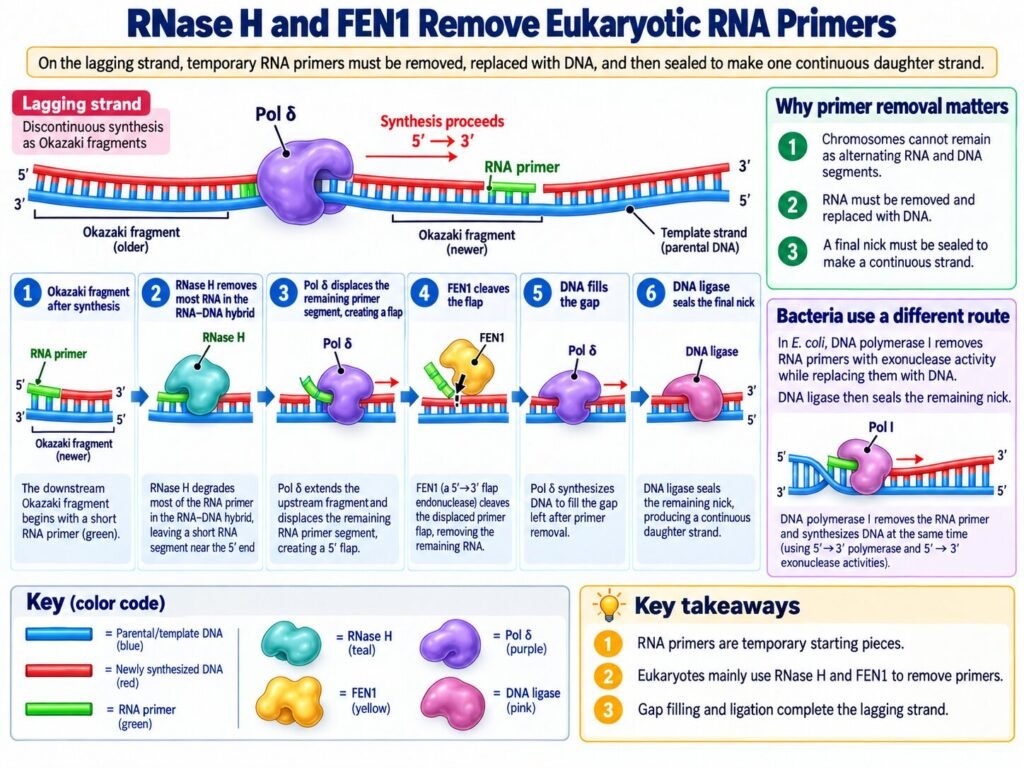
Primer removal is more than cleanup. A newly copied chromosome cannot remain as alternating pieces of RNA and DNA. The RNA must be removed, the missing nucleotides filled with DNA, and the final nick sealed.
Bacteria use a somewhat different route. In *E. coli*, DNA polymerase I removes RNA primers with its exonuclease activity while replacing them with DNA.
DNA ligase seals breaks in the sugar-phosphate backbone
DNA ligase finishes one of the last steps in lagging-strand synthesis. After RNA primers have been removed and the resulting spaces filled with DNA, small nicks remain between adjacent fragments.
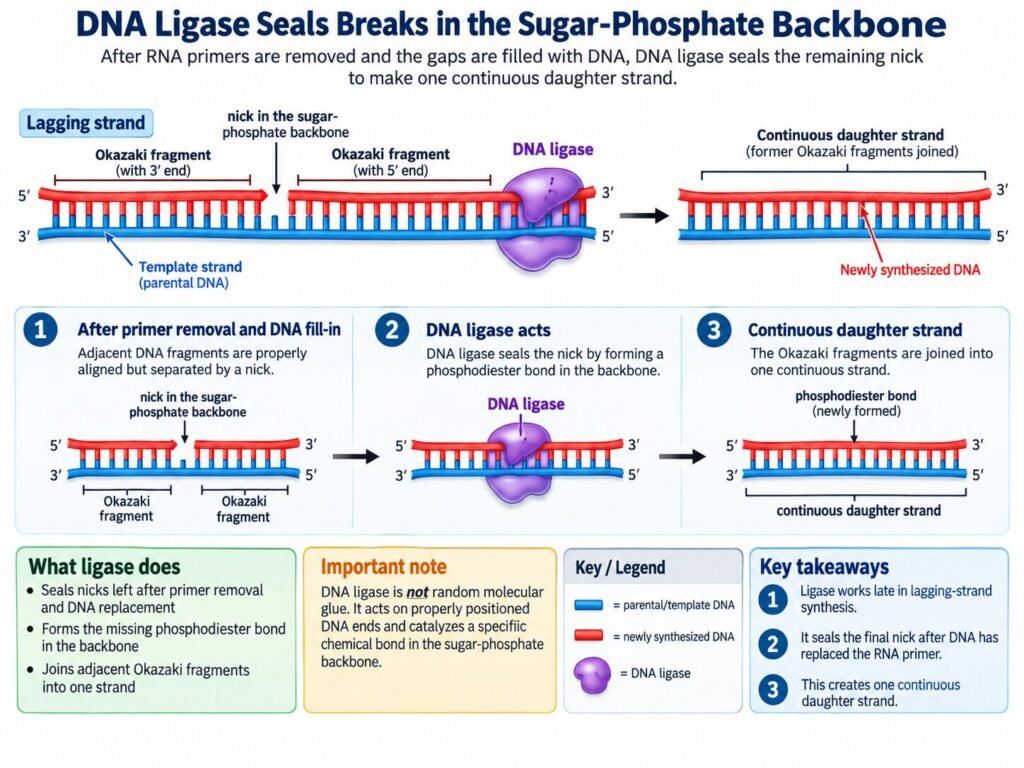
Ligase seals those nicks by forming the missing phosphodiester bond in the DNA backbone. The separate Okazaki fragments then become one continuous daughter strand.
Ligase is sometimes described as molecular glue, but that description can be misleading. It does not simply stick two loose DNA molecules together at random. It acts on properly positioned DNA ends and catalyzes a specific chemical bond in the backbone.
Telomerase helps copy the ends of linear chromosomes
Eukaryotic chromosomes create a special problem because they are linear. After the final RNA primer on a lagging strand is removed, ordinary DNA polymerases cannot completely fill the extreme chromosome end.
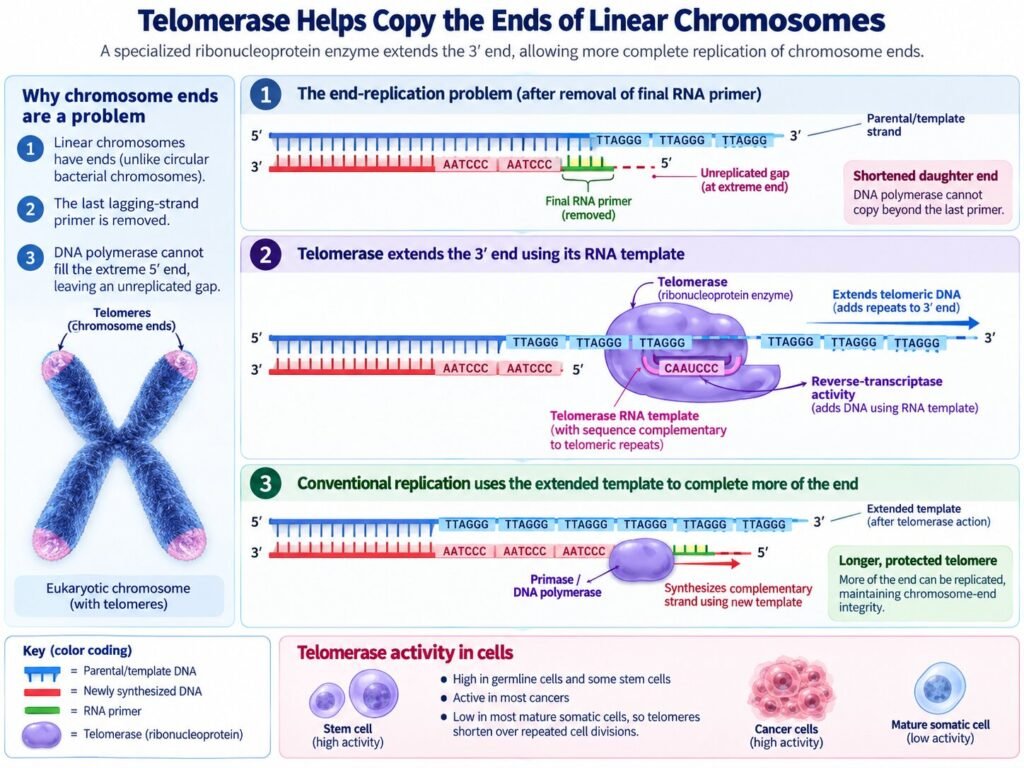
Telomerase addresses this end-replication problem. It is a ribonucleoprotein enzyme with its own RNA template and reverse-transcriptase activity. It extends telomeric DNA so conventional replication machinery can complete more of the complementary strand.
Telomerase activity is tightly regulated. It is found in germline and certain stem-cell populations and is active in most cancers. Most mature human somatic cells have much lower activity, so telomeres generally shorten over repeated cell divisions.
How do DNA replication enzymes work together at the replication fork?
The replisome works as a connected molecular machine. Helicase, polymerases, primase, clamps, and many supporting proteins stay physically or functionally connected so that DNA unwinding and DNA synthesis occur in step with one another.
Replication starts at an origin
Initiator proteins first recognize a replication origin and help prepare the site for DNA opening. Helicase is loaded or activated, and two forks usually move away from the origin in opposite directions.
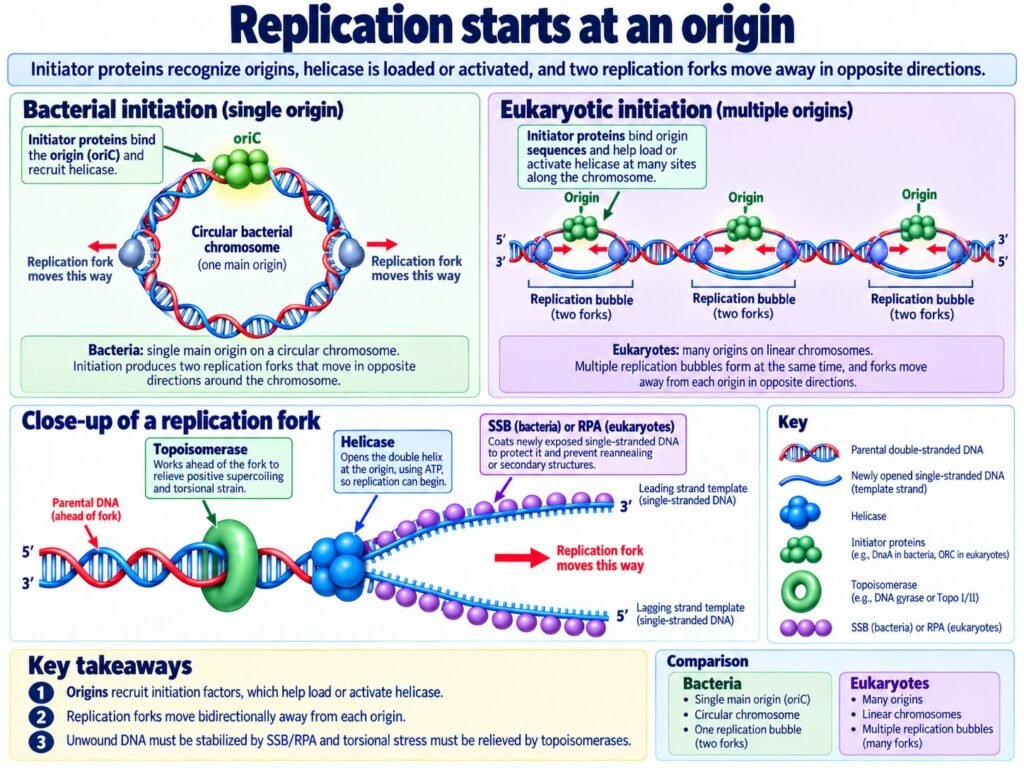
Bacterial chromosomes commonly use a single primary origin on a circular chromosome. Eukaryotic chromosomes are much larger and linear, so they use many origins distributed across each chromosome.
Once a fork is established, helicase moves forward and opens parental DNA. Topoisomerase works ahead of the fork, while SSB or RPA coats newly exposed single-stranded DNA behind it.
The leading strand is copied continuously
Primase first provides a primer. The main replicative polymerase then extends the new strand in the same overall direction as fork movement.
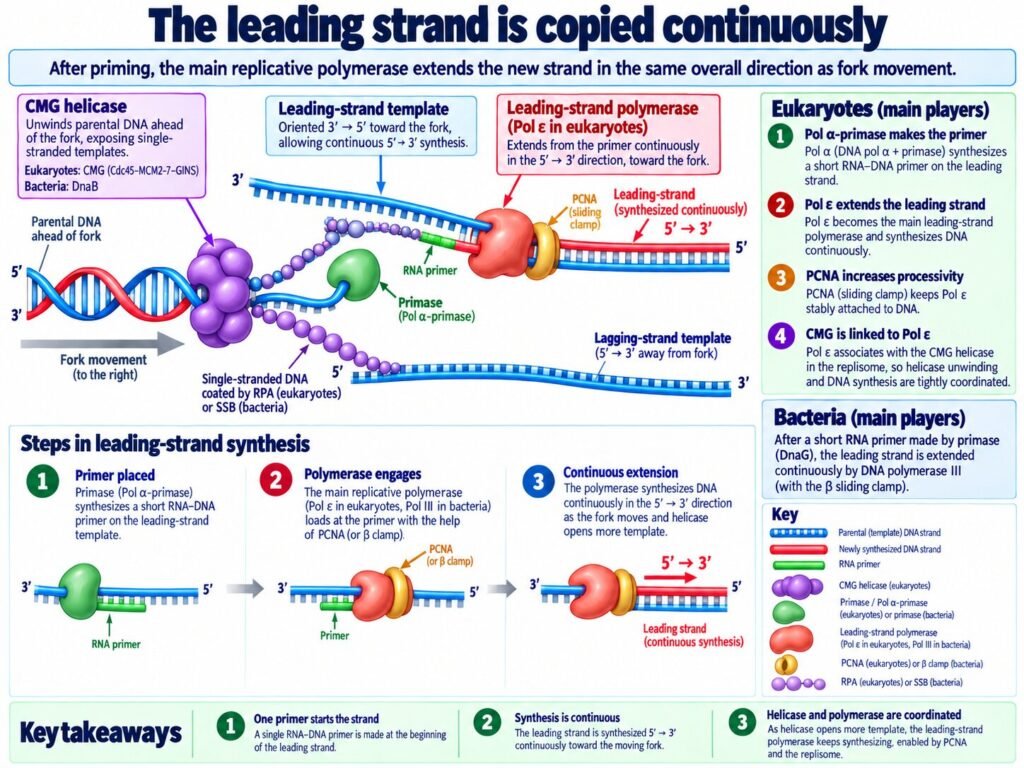
In eukaryotes, Pol α-primase starts the primer, after which Pol ε becomes the main leading-strand polymerase. PCNA can support polymerase processivity, while the CMG helicase and Pol ε remain closely linked within the replisome.
Because the leading-strand template is oriented correctly for continuous 5′ to 3′ synthesis, the polymerase can keep moving as the helicase exposes more template.
The lagging strand is copied as Okazaki fragments
The opposite template faces a geometric problem. DNA polymerase still has to build DNA 5′ to 3′, but the template runs in the other direction relative to fork movement.
The cell solves this by copying the lagging strand in short sections. Primase repeatedly places new primers near the fork. A polymerase extends each primer away from the fork until it reaches the previous fragment.
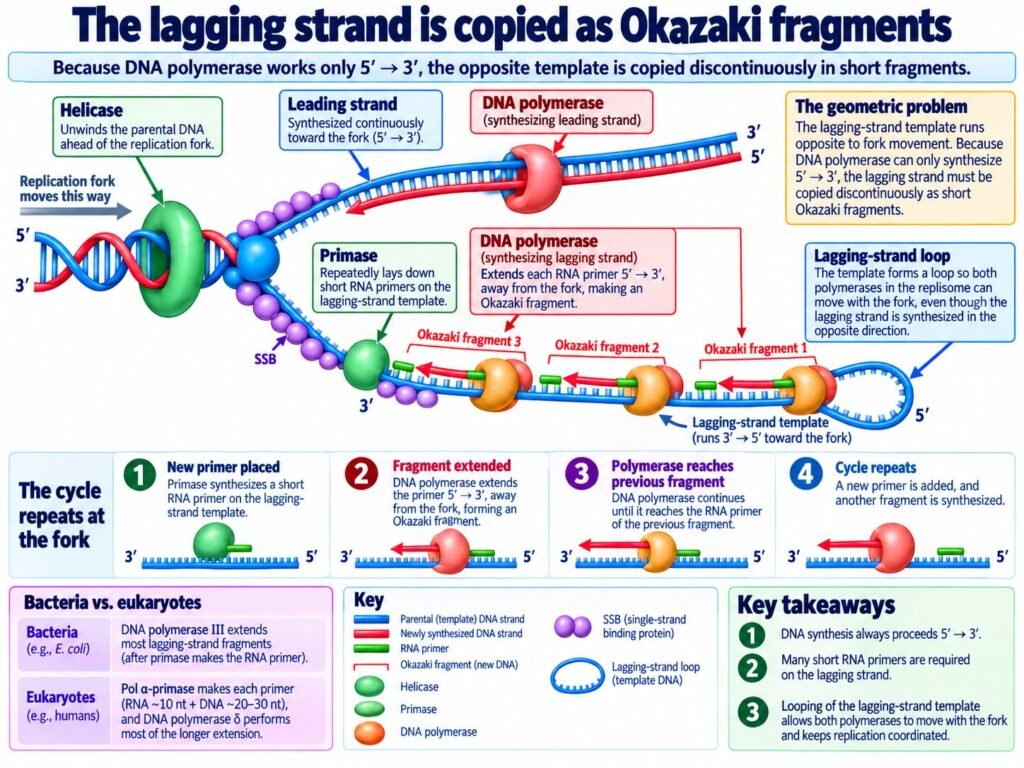
In bacteria, DNA polymerase III carries out most of this extension. In eukaryotes, Pol α-primase begins each fragment and Pol δ performs most of the longer extension.
The lagging-strand template can form loops within the replisome, allowing the polymerases working on the two daughter strands to remain coordinated even though the new DNA is being built in opposite local directions.
Primer removal and ligation finish the strand
After an Okazaki fragment has been made, its RNA primer cannot stay in the chromosome. Primer-processing enzymes remove it, DNA synthesis fills the resulting region, and ligase seals the remaining nick.
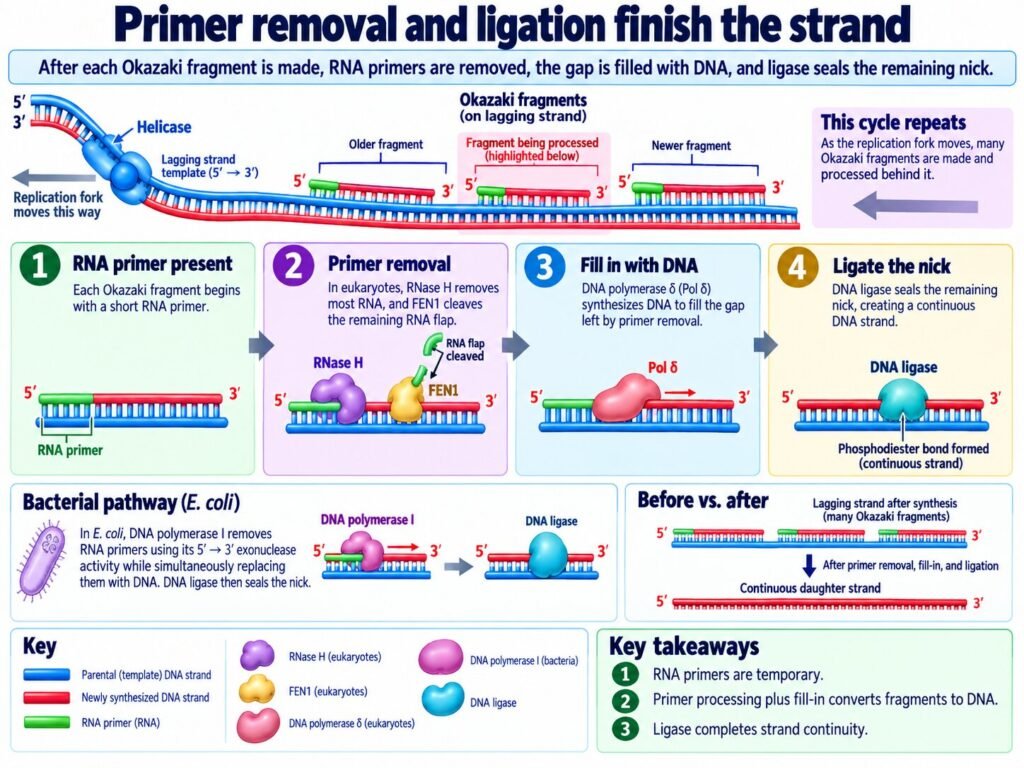
This cycle occurs again and again behind the moving replication fork. The end result is a continuous daughter DNA molecule, even though part of it was originally built as hundreds or thousands of separate fragments.
DNA replication enzymes in bacteria and eukaryotes
Bacteria and eukaryotes follow the same basic chemical rules, but they often use different proteins for the same job. Eukaryotic replication also operates on linear chromosomes packaged in chromatin, which adds extra layers of control.
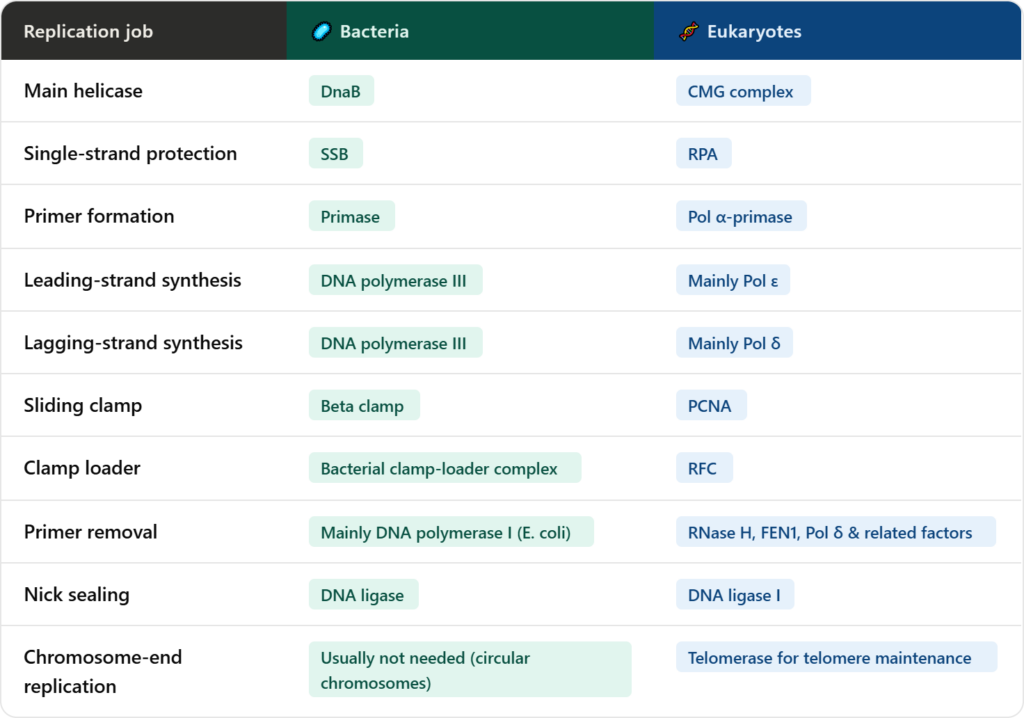
The comparison is useful, but it should not be read as though every organism uses an identical version of the bacterial or eukaryotic scheme. Replication proteins vary across species, and archaea have a replication system that shares several features with eukaryotes.
How does DNA polymerase proofread newly copied DNA?
Many replicative DNA polymerases can detect a mismatched base shortly after it is inserted. Their 3′ to 5′ exonuclease activity removes the incorrect nucleotide, after which polymerization can resume from the corrected end.
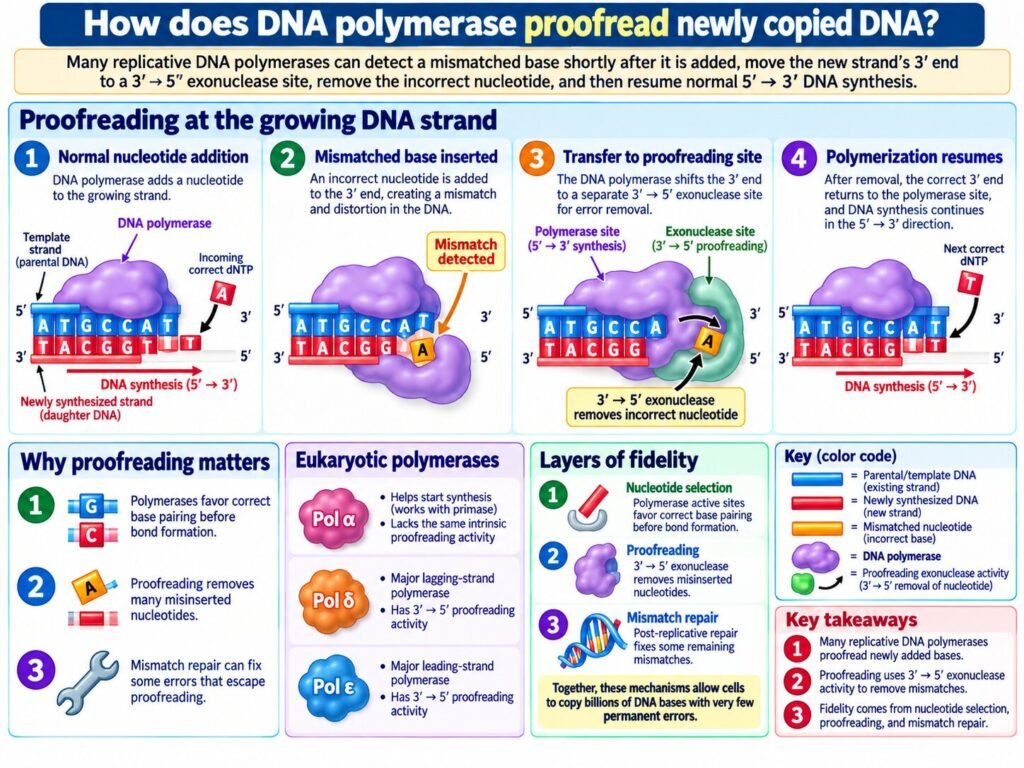
Proofreading is one layer of replication fidelity rather than the whole system. Polymerases already favor correct base pairing before bond formation, and mismatch repair can correct some errors that escape the replication machinery.
Pol α is an interesting exception in eukaryotes because it lacks the same intrinsic proofreading activity found in Pol δ and Pol ε. Its DNA contribution is kept relatively short before another polymerase takes over.
The combined accuracy of nucleotide selection, proofreading, and mismatch repair is why cells can copy billions of DNA bases while leaving very few permanent errors.
What happens if a DNA replication enzyme does not work correctly?
A defective replication enzyme can slow or stall replication forks, increase mutation rates, leave DNA breaks, or prevent chromosomes from being copied fully. The outcome depends on which protein is affected and how much function is lost.
A helicase defect can interfere with fork movement. A faulty polymerase can raise the number of base-copying errors. Problems with ligase or Okazaki-fragment processing can leave unsealed or improperly processed DNA. Defects in topoisomerases can create severe problems with DNA topology and chromosome separation.
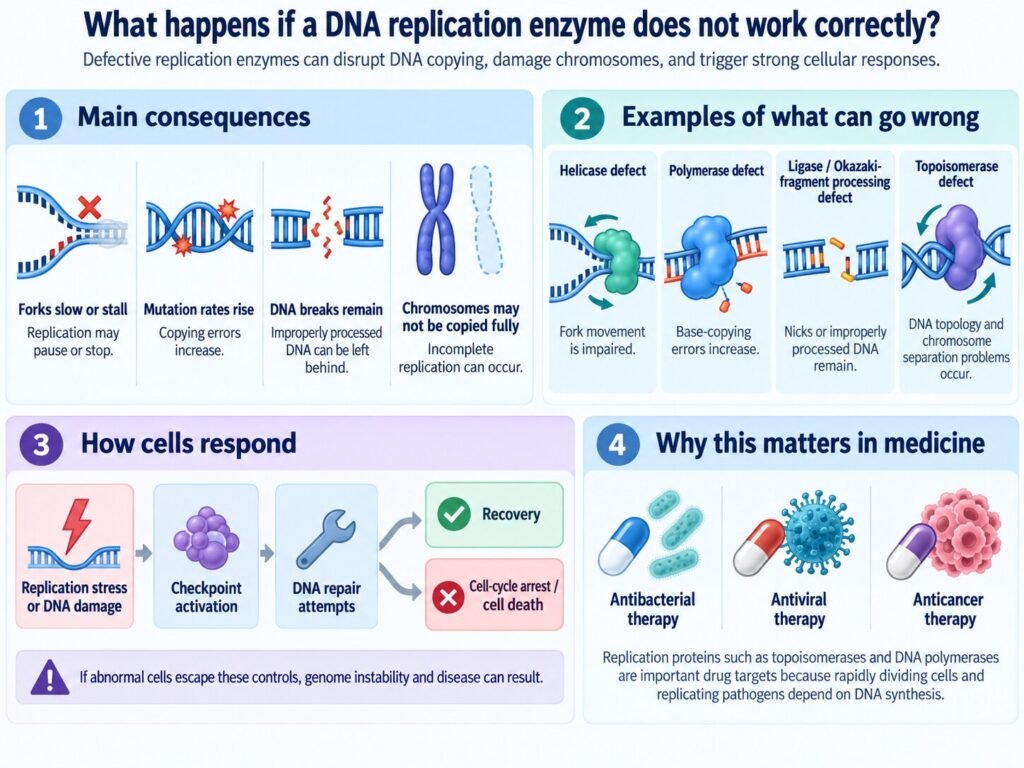
Cells have checkpoint and repair systems that respond when replication stalls or DNA becomes damaged. If the damage cannot be dealt with, the cell may stop dividing or enter cell death pathways. When abnormal cells escape those controls, replication errors can contribute to genome instability and disease.
Several replication enzymes are also drug targets. Topoisomerases, DNA polymerases, and proteins connected with replication have been targeted in antibacterial, antiviral, and anticancer therapy because rapidly dividing cells or replicating pathogens depend heavily on DNA synthesis.
Which enzyme is most important in DNA replication?
There is no single enzyme that can complete DNA replication alone. DNA polymerase is the enzyme that actually builds most of the new DNA, but it cannot begin synthesis without a primer and cannot gain access to the template until helicase opens the helix.
Calling one enzyme “the most important” misses how the replisome works. Remove helicase, primase, the main polymerase, topoisomerase, or ligase, and replication either stops or produces incomplete DNA.
The better way to think about the system is dependency. Each major enzyme solves a problem that another part of the process creates.
What is the difference between helicase, primase, polymerase, and ligase?
Helicase opens parental DNA. Primase creates the short starting primer. DNA polymerase extends that primer by adding DNA nucleotides. DNA ligase seals the remaining breaks between adjacent DNA sections.
Those four names cover the core sequence students often need to remember, but a real replication fork contains more machinery. Topoisomerases handle torsional stress, SSB or RPA protects exposed DNA, clamps keep polymerases attached, and primer-processing enzymes prepare Okazaki fragments for ligation.
Remembering the enzymes as a sequence of jobs is usually easier than memorizing names in isolation: open, stabilize, prime, copy, remove the primer, fill the gap, and seal the backbone.
DNA replication works because the enzymes act as one system
DNA replication is often taught as a list of enzymes, yet the process makes more sense when those enzymes are seen as parts of one moving machine. Helicase exposes the template, topoisomerase controls twisting, SSB or RPA protects single-stranded DNA, primase provides a starting point, polymerases copy the strands, and ligase closes the final nicks.
The leading and lagging strands force the replisome to solve the same copying problem in two different ways. One strand can be made almost continuously, while the other must be repeatedly primed, extended, processed, and joined.
That coordinated work gives cells a way to duplicate an enormous amount of genetic information with speed and extraordinary accuracy. Learning what each enzyme does is useful; seeing how each one hands the DNA to the next is what makes the full mechanism click.