What Is a No-Template Control in Sequence Detection Testing?
A no-template control in sequence detection testing is a blank test reaction that contains every testing ingredient except the DNA or RNA sample being checked. Its job is simple: prove that a positive signal came from the real sample, not from contaminated reagents, carryover DNA, primer-dimers, or accidental sample transfer. In PCR, qPCR, RT-qPCR, and some next-generation sequencing workflows, this control is often called an NTC, negative template control, or reagent contamination control.
No-template control tells the lab whether the test system is clean before patient, food, forensic, research, or environmental results are trusted. If the NTC shows amplification or sequence reads that should not be there, the run may be invalid, because a “positive” result could be false. An NTC contains all real-time PCR components except the template, so any signal in that blank reaction can point to reagent contamination.
What does a no-template control mean in sequence detection testing?
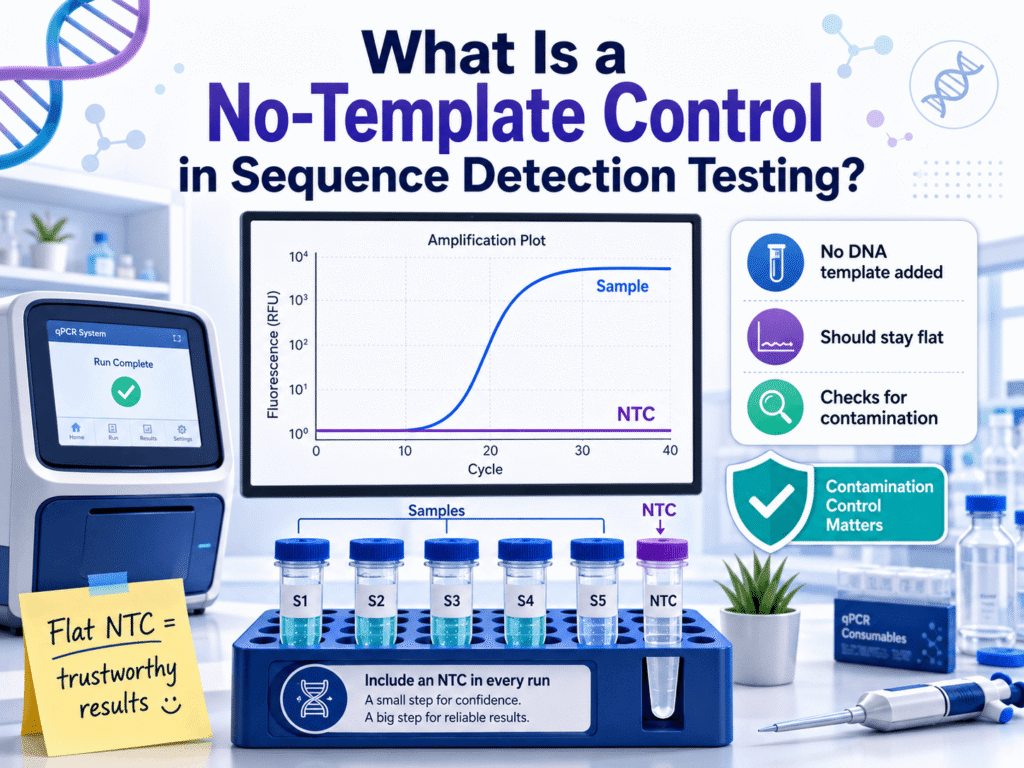
A no-template control means the test is run without target nucleic acid. The lab replaces the sample DNA or RNA with clean water or buffer while keeping the same primers, probes, enzymes, nucleotides, master mix, and cycling conditions.
That blank reaction should stay negative.
In sequence detection testing, the word “template” refers to the DNA or RNA strand that the assay copies, detects, or reads. When no template is added, the reaction should have nothing meaningful to copy. If the instrument still detects a signal, something has entered the reaction that should not be there.
That “something” could be amplified DNA from a past run, target material in a reagent, cross-contamination from a nearby positive sample, or primer-dimer signal in dye-based qPCR chemistry. When an NTC amplifies, the usual suspects are stray DNA, carryover amplicons, or primer-dimers that create signal even though no sample was added.
The NTC is a quiet but powerful safeguard. It does not tell you whether a sample was collected well. It does not prove extraction worked. It does not show whether inhibitors are present. It answers one narrow question: did the reaction produce a signal even when no sample was added?
Why is a no-template control used in PCR and qPCR?
A no-template control is used in PCR and qPCR to detect contamination and false-positive signal. In real-time PCR, even a tiny amount of target DNA can be copied many times, which makes the method sensitive but also vulnerable to stray nucleic acids.
PCR works by copying target nucleic acid through repeated cycles. That is why it can detect small amounts of genetic material. The same sensitivity can become a problem when previous PCR products, positive-control material, or sample droplets enter a blank reaction.
NTC wells contain qPCR components such as primers, master mix, and water, but no sample nucleic acid; amplification in these wells points to possible contamination from reaction components or the surrounding environment.
In qPCR, the NTC is watched through the amplification curve and Cq or Ct value. A clean NTC should show no true amplification curve. If the NTC crosses the threshold, the analyst must ask whether the result reflects contamination, nonspecific signal, or primer-dimer behavior.
Sequence detection testing often supports decisions in clinical diagnosis, pathogen screening, genetic research, food safety, plant testing, and contamination monitoring. A false positive can send people in the wrong direction. It may lead to repeat sampling, wrong diagnosis, unnecessary treatment, delayed product release, or flawed research findings.
What is inside a no-template control reaction?
A no-template control contains the full reaction mix but replaces the sample with nuclease-free water or another approved blank material. The point is to test the same reagents and conditions used for real samples.
A typical PCR or qPCR NTC may include:
- PCR-grade water instead of sample DNA or RNA
- Primers
- Probe, if the assay uses probe-based detection
- Polymerase or reverse transcriptase-polymerase mix
- dNTPs
- Buffer and salts
- Fluorescent dye or master mix
- The same reaction volume used for samples
In clinical real-time PCR workflows, PCR-grade water is often added in place of extracted DNA to create the no-template control. NTC should be included in each run and should return negative results for the target and control markers in that setup.
The design is plain on purpose. The NTC mimics a sample reaction closely, but it removes the one thing that should create a target signal: the template.
How does a no-template control work?
A no-template control works by exposing unwanted amplification. Since no target sample is added, any detected signal suggests the reaction system is not fully clean or the assay chemistry is producing a non-target product.
In endpoint PCR, the NTC may be checked by gel electrophoresis. A clean NTC should show no target-sized band. A band in the NTC can suggest contamination or nonspecific amplification.
In qPCR, the NTC is checked through fluorescence. A clean NTC should not cross the fluorescence threshold in a target-like pattern. If it does, the lab compares the curve shape, melt curve if used, Ct/Cq value, replicate behavior, and assay rules.
In sequencing workflows, the no-template control can be carried through library preparation. Its output may be checked for reads, barcode leakage, index hopping, reagent background, or unexpected organism signals. The Association for Molecular Pathology and College of American Pathologists validation guideline for targeted NGS recommends including a no-template control in library preparation to verify that reagents are not contaminated.
That makes the NTC more than a blank tube. It is a warning system built into the run.
What happens if the no-template control is positive?
If the no-template control is positive, the test run may be invalid or need investigation. A positive NTC means the assay produced detectable signal without sample template, so the lab cannot assume every sample signal is real.
The response depends on the assay, laboratory rules, and the signal pattern.
If the NTC shows strong target-like amplification, the safest interpretation is contamination until proven otherwise. If only one late weak curve appears in one NTC replicate, the lab may examine melt curves, replicate behavior, threshold placement, and control acceptance criteria. Still, many regulated or diagnostic workflows require rerunning affected samples when the NTC fails.
In real-time PCR if the NTC gives a positive result for the target or control marker described in that assay, patient specimen results should be invalidated and PCR should be rerun from the post-extraction step.
A positive NTC does not always mean the sample is contaminated. It means the testing environment, reagents, or assay behavior has created a signal where none should exist. That is enough to pause interpretation.
What can cause amplification in a no-template control?
Amplification in a no-template control can come from DNA contamination, carryover amplicons, cross-well transfer, contaminated water or primers, reagent background, or primer-dimers. The cause is not always obvious from the Ct value alone.
The most common source in many PCR labs is amplicon carryover. PCR products from earlier reactions are abundant, small, and easy to spread through aerosols, gloves, pipettes, benches, or opened tubes.
A common source of DNA contamination comes from PCR products of previous experiments and advises PCR-grade reagents, fresh tips, gloves, and careful labware handling.
Random contamination can also happen during plate setup. A droplet from a high-copy sample may land in or near the NTC well. Random NTC contamination during template loading, often showing variable Ct values across affected wells.
Primer-dimers are another frequent issue, especially in SYBR Green assays. SYBR Green binds double-stranded DNA, so it can report signal from primer-dimers as well as target amplicons. Some NTC signals are not caused by target contamination at all. Primers can bind to each other, extend, and create primer-dimer products that look like amplification in dye-based assays.
In sequencing, the cause may be low-level reagent background rather than a single dramatic contamination event. This is especially relevant in low-biomass microbiome, metagenomics, environmental, and pathogen-screening assays, where small amounts of nucleic acid in water, kits, plastics, or lab air may become visible after amplification and sequencing.
Is a no-template control the same as a negative control?
A no-template control is a type of negative control, but not every negative control is an NTC. The NTC checks the amplification or detection reaction without sample template. Other negative controls may check extraction, sampling, matrix effects, or carryover across a wider part of the workflow.
A no-template control usually starts at the PCR or library preparation step. It tells you whether the reaction components and setup are clean. An extraction negative control, often called a blank extraction control, goes through extraction with no specimen. That control can catch contamination introduced during extraction, handling, or kit processing.
A negative sample control may contain known negative biological material. It checks whether the assay behaves correctly with a real sample matrix that should not contain the target.
In short, the NTC asks: Did the reaction itself stay clean?
The extraction blank asks: Did the extraction process stay clean?
The negative sample control asks: Did a known negative specimen remain negative under the test conditions?
For high-sensitivity testing, labs may use all three because each one guards a different weak point.
How is a no-template control different from a positive control?
A no-template control should be negative, while a positive control should be positive. Together, they tell the lab whether the assay stayed clean and whether the assay can detect the target when it is present.
The positive control contains target material or a synthetic target sequence. It proves that primers, probes, enzymes, cycling conditions, and detection settings can produce the expected signal.
The NTC contains no target. It proves that the signal is not appearing on its own.
If the positive control fails, the run may have reagent failure, thermal cycling trouble, wrong setup, inhibition, or degraded control material. If the NTC fails, the concern moves toward contamination, nonspecific signal, or assay artifacts.
Both controls are needed because they answer different questions. A run with a good positive control but a positive NTC is still questionable. A run with a clean NTC but failed positive control is also not trustworthy.
Why is a no-template control important in sequence detection testing?
A no-template control is important because sequence detection tests can detect tiny amounts of nucleic acid. That sensitivity is useful only when the lab can separate true target signal from background noise.
In clinical testing, a false positive can affect patient management. In public health labs, it can distort outbreak tracking. In food or water testing, it can trigger costly follow-up. In research, it can lead to wrong gene-expression claims or misleading microbiome profiles.
The MIQE guidelines, widely cited in qPCR reporting, include NTCs in the language and reporting structure around reliable real-time PCR experiments.
A well-placed NTC also protects confidence. When the NTC is clean, a positive sample result becomes easier to trust. When the NTC fails, the lab has evidence that something went wrong before those results leave the bench.
This is one reason experienced molecular scientists do not see controls as extra work. Controls are part of the result.
What does a clean no-template control look like?
A clean no-template control shows no target amplification, no target-sized band, or no meaningful sequence reads above the lab’s acceptance limit. The exact definition depends on the method.
In qPCR, a clean NTC usually has no Cq/Ct value for the target. Some instruments may display late baseline drift, but that is not the same as true amplification. The analyst checks the curve shape, threshold, melt curve, and assay-specific rules.
In gel-based PCR, a clean NTC shows no visible band at the target size. Smears or faint nonspecific bands may still need review.
In NGS, a clean NTC may still produce a very small number of reads because sequencing is highly sensitive. The question is whether those reads match known background limits, whether they appear in sample-associated taxa or variants, and whether they cross reporting thresholds.
NGS workflows often require a reagent contamination control during amplification or library preparation, because contamination can move across samples and reagents before sequencing begins.
For that reason, “clean” means more than “nothing happened.” It means the result stayed within the lab’s defined acceptance criteria.
Can a no-template control show late amplification?
Yes, a no-template control can show late amplification, and the lab must decide whether it is contamination, primer-dimer signal, baseline noise, or a nonspecific product. Late curves are common enough that they should not be ignored or accepted blindly.
A late NTC signal in qPCR may occur near the assay’s limit of detection. It may also appear because primer-dimers slowly build up over many cycles. If the assay uses SYBR Green, melt-curve analysis can help separate the target product from primer-dimers because they often melt at different temperatures.
Probe-based assays are less prone to dye-based primer-dimer signal, but they are not immune to contamination. A late probe signal in the NTC still deserves review.
The safest lab habit is to define rules before testing begins. For example, the assay procedure may state that any target amplification in the NTC invalidates the run, or it may allow late nonspecific signal only when melt-curve and replicate criteria support that decision. In regulated testing, local validation and approved standard operating procedures control how this is handled.
How is a no-template control used in next-generation sequencing?
In next-generation sequencing, a no-template control is used to check whether library preparation, amplification, indexes, reagents, or handling steps introduce unwanted nucleic acid. It is especially helpful when testing low-input or low-biomass samples.
Targeted NGS often includes PCR enrichment or library amplification. If the NTC generates target-like reads, the run may have contamination from amplicons, positive samples, barcode mix-ups, or reagent carryover.
For metagenomic sequencing, the NTC can reveal background organisms that came from kits, water, plastics, or the lab environment. This is a serious concern when the sample contains little microbial DNA. A contaminant that looks minor in a high-biomass sample may dominate a low-biomass sample.
In targeted NGS, the no-template control is often carried through library preparation so reagent contamination can be caught before reads are assigned to real samples.
The control should travel through the same major workflow steps as the samples whenever possible. If it is added only at the end, it may miss contamination introduced earlier.
Where should the no-template control be placed in the workflow?
The no-template control should be placed at the step it is meant to monitor. In PCR, it is usually added during reaction setup. In NGS, it may be added at library preparation or amplification steps. For full-process contamination checks, labs also add extraction blanks.
Placement affects what kind of contamination the control can catch.
If the NTC is added only during PCR setup, it will not catch contamination introduced during extraction. If it is added during library preparation, it can help catch reagent or setup contamination in that part of the process. If a blank extraction control is processed from the start, it gives a broader view of the workflow.
The CDC example for real-time PCR setup adds PCR-grade water into NTC wells before moving the reaction plate to the specimen nucleic acid handling area, which helps protect the NTC from template handling steps during setup.
Good placement is about matching the control to the risk.
What are common mistakes when using a no-template control?
The most common mistake is treating the NTC as a checkbox instead of a decision point. A control only protects the result when the lab has clear rules for what happens if it fails.
Another mistake is using only one NTC in a large or high-risk plate. More than one blank well can help reveal random contamination patterns. For example, one positive NTC near a cluster of high-copy samples may suggest a loading event, while several NTCs across the plate may point toward contaminated master mix.
Poor plate layout can also hide problems. Placing NTCs only at the edge of the plate may fail to catch contamination in busy sample areas. In high-throughput settings, labs often think carefully about where controls sit in relation to positive controls and high-copy samples.
Reusing opened water, leaving tubes exposed, preparing PCR mix near amplified product, or handling positive controls before NTCs can raise contamination risk. Clean gloves, fresh pipette tips, PCR-grade materials, freshly prepared or properly aliquoted reagents, and strict separation from old PCR products help keep the no-template control clean.
A final mistake is ignoring weak NTC signal because sample signals look stronger. Strong sample signals do not erase evidence of contamination. They only make the investigation more urgent.
How do labs reduce no-template control contamination?
Labs reduce NTC contamination through physical separation, clean technique, careful reagent handling, and clear workflow rules. Prevention is easier than troubleshooting a failed run after samples have already been processed.
Common steps include keeping pre-PCR and post-PCR areas separate, using aerosol-resistant tips, changing gloves often, preparing master mix in a clean area, aliquoting reagents, cleaning benches, and opening tubes carefully.
Many labs use unidirectional workflow, meaning materials move from clean areas toward amplified-product areas, not backward. Positive controls and high-copy material are handled with extra care because they can contaminate many future reactions.
Primer design can also influence NTC signal. If the NTC signal is caused by primer-dimers, better primer design, lower primer concentration, adjusted annealing temperature, or probe-based chemistry may help. New England Biolabs notes that primer design tools often try to reduce primer structures that can create primer-dimer products.
The best prevention plan treats contamination as a normal lab risk, not a rare accident. Molecular assays are sensitive enough that tiny habits matter.
What should a lab report say about a no-template control?
A lab report or run record should state whether the no-template control passed or failed according to assay rules. In research settings, methods sections should also describe the controls used, especially for qPCR and sequencing assays.
For qPCR studies, transparent reporting helps readers judge whether amplification results are reliable. The MIQE guidelines were created to raise the quality and clarity of qPCR experiment reporting, and NTC is part of the control vocabulary used in that framework.
For clinical or regulated testing, the final patient or sample report may not list every control detail, but the laboratory record should contain it. The run cannot be judged properly without knowing whether controls behaved as expected.
At minimum, internal records often include NTC well position, target result, Ct/Cq if present, melt-curve result if used, analyst review, pass/fail status, and corrective action if needed.
Why the no-template control is small but powerful
A no-template control may look like the simplest tube in the run, yet it carries a serious responsibility. It asks the question every sequence detection test must answer before a result can be trusted: would this assay still look positive even if no real sample were present?
That question protects patients, researchers, manufacturers, public health teams, and anyone relying on molecular data.
When the NTC stays negative, the test has a cleaner foundation. When it turns positive, it gives the lab a chance to stop a false result before it travels any further. In sequence detection testing, that quiet blank reaction is often the difference between a confident answer and a costly mistake.