The Difference Between Applied Biosystems 7500 and Other Sequence Detection Systems
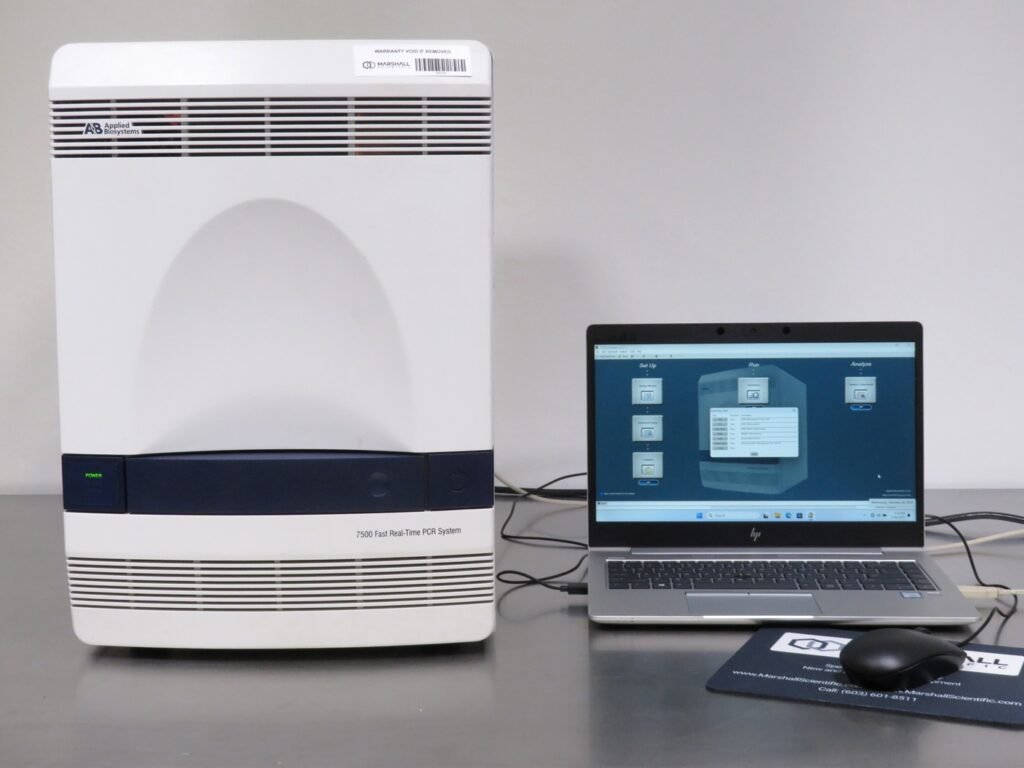
The Applied Biosystems 7500 Real-Time PCR System is a 96-well sequence detection system built for real-time PCR, gene expression, SNP genotyping, pathogen detection, and other nucleic acid quantification work. Its main difference from many newer sequence detection systems is that it is a trusted, older Applied Biosystems platform with strong dye flexibility, five-color detection, and familiar SDS software, while newer systems such as QuantStudio, Bio-Rad CFX, and Roche LightCycler models often bring faster workflows, touchscreen operation, cloud-connected software, broader formats, or higher multiplexing convenience.
The Applied Biosystems 7500 is still valued for reliable 96-well qPCR work, but other systems may be better when a lab needs newer software, faster runs, 384-well capacity, modern compliance tools, or long-term vendor support. The 7500 and 7500 Fast are now nearing the end of their active sales life, with sales discontinuation beginning October 31, 2025. That matters for new buyers because newer QuantStudio systems offer a clearer path for support, software, and long-term use.
What is the Applied Biosystems 7500 sequence detection system?
The Applied Biosystems 7500 belongs to the wider family of DNA and PCR detection systems. It is a real-time PCR instrument used to detect and measure nucleic acids as PCR amplification happens. It reads fluorescence signals from dyes or probes during each PCR cycle, allowing labs to measure DNA or RNA targets without waiting for end-point gel analysis.
In practical lab language, the 7500 is a qPCR sequence detection system. It does not sequence DNA base by base like a next-generation sequencer. Instead, it detects specific target sequences through real-time PCR chemistry.
That makes it useful for applications such as gene expression, viral or bacterial target detection, copy number studies, allelic discrimination, and assay validation. The 7500 and 7500 Fast systems were built as multicolor real-time PCR platforms, which is one reason they became common in labs running TaqMan probes, SYBR Green assays, and other fluorescence-based qPCR workflows.
The system became popular because it offered a balance many labs needed: a 96-well format, broad dye support, Applied Biosystems assay compatibility, and software that many molecular biology teams already knew.
How is the Applied Biosystems 7500 different from basic PCR machines?
The Applied Biosystems 7500 differs from a basic PCR machine because it detects fluorescence during amplification. A regular PCR thermocycler only amplifies DNA. The 7500 amplifies and measures the signal in real time.
A standard PCR machine usually tells you whether a target may be present after amplification is complete. The sample is often checked later through gel electrophoresis or another end-point method.
The 7500 gives a cycle-by-cycle amplification curve. This lets researchers measure Ct or Cq values, compare target abundance, and quantify starting material across samples.
That difference matters when a lab needs numbers, not just a yes-or-no answer. For example, gene expression studies need relative expression levels. Viral load assays need measurable target quantity. Quality control studies need repeatable threshold data.
The 7500 is also built with an optical system, thermal block, fluorescence filters, and software designed around real-time detection. That is why it sits in a different class from ordinary PCR thermocyclers.
What is the biggest difference between Applied Biosystems 7500 and newer QuantStudio systems?
The biggest difference is age, software design, and long-term support. The 7500 is a mature 96-well platform, while QuantStudio systems are newer Applied Biosystems instruments with more modern interfaces, easier software, and stronger upgrade paths.
The RUO 7500 and 7500 Fast are moving out of active sales beginning October 31, 2025, so labs buying today should think carefully about service life, software support, and future replacement options. Newer QuantStudio systems, including QuantStudio 3/5 and QuantStudio 6/7 Pro models, give labs a more current path with updated hardware, newer software, and a platform built for longer future use.
That does not mean the 7500 suddenly becomes useless. Many labs still use older instruments for validated assays, routine workflows, and legacy protocols.
The difference is more about future readiness. A lab buying a system now may care about service life, software updates, computer compatibility, data transfer, cybersecurity rules, and compliance documentation. Newer QuantStudio systems are usually easier to fit into those expectations.
QuantStudio 3 and 5 systems also promote an interactive touchscreen, intuitive instrument software, and preloaded protocol templates, which reduce training time for newer users.
Applied Biosystems 7500 vs 7500 Fast: what changed?
The 7500 Fast is designed for shorter qPCR runs, while the standard 7500 is built for traditional real-time PCR cycling. Both use a 96-well format, but the Fast version uses a high-speed block and fast cycling chemistry to cut run time.
The 7500 Fast was built for shorter 96-well qPCR runs, with fast cycling workflows that can bring run time down to about 35 minutes, while the standard 7500 usually follows longer traditional runs under 2 hours.
With the right fast cycling setup, the 7500 Fast can shorten some real-time PCR workflows to around 30 minutes.
For labs processing many plates per day, that time difference can matter. A fast system can raise daily sample throughput without moving to 384-well plates.
The tradeoff is that fast cycling usually needs compatible plastics, master mixes, validated cycling conditions, and careful assay setup. Labs with older assays may prefer the standard 7500 if their protocols were built around traditional 96-well qPCR runs.
How does the optical system compare with other real-time PCR instruments?
The Applied Biosystems 7500 uses five-color fluorescence detection, which gives it strong dye flexibility for many common qPCR chemistries. Some newer systems use LED-based optics, more modern filter designs, or wider software support for multiplex assays.
Inside the 7500 Fast, the optical setup is built around a CCD camera, halogen lamp excitation, and five excitation and five emission filters. That setup supports familiar qPCR dye channels such as FAM/SYBR Green, VIC/JOE, NED/TAMRA/Cy3, ROX/Texas Red, and Cy5.
That dye range is one reason the 7500 stayed popular. Labs using TaqMan probes, SYBR Green assays, or multi-dye plates could run a wide set of assays without buying a highly specialized instrument.
Other sequence detection systems may differ in how they excite and read dyes. For example, the Bio-Rad CFX96 Touch gives labs six-channel detection, including five color channels and one FRET channel, which can be useful when teams run multiplex assays with several targets in the same plate.
Roche’s LightCycler 480 II is more flexible for higher-throughput work because it is available in both 96-well and 384-well formats, while the Applied Biosystems 7500 is mainly tied to the standard 96-well workflow.
The 7500 is strong for five-color 96-well qPCR. Other systems may be stronger when the lab needs newer optics, faster scanning, more flexible plate formats, or software built for modern data handling.
Is the Applied Biosystems 7500 less advanced than QuantStudio 5?
The Applied Biosystems 7500 is older than QuantStudio 5, so QuantStudio 5 is usually the more modern choice for a new purchase. The 7500 can still be reliable for established qPCR work, but QuantStudio 5 has newer software, interface, and workflow features.
QuantStudio 5 is a more current fit for labs that want reliable real-time PCR while moving into newer quantification chemistries and updated analysis software. QuantStudio 3 and 5 also bring touchscreen operation and protocol templates, two everyday workflow features the older 7500 experience does not really offer.
The 7500 often depends on a connected computer running SDS or related software. The 7500 still has available software downloads such as SDS v1.5.1 and 7500 Software v2.3, but its software environment clearly belongs to an older generation of lab computing.
For a lab already trained on the 7500, that may be fine. For a new lab, QuantStudio 5 may feel easier to teach, easier to manage, and safer as a long-term platform.
Applied Biosystems 7500 vs Bio-Rad CFX96: which is better?
The Applied Biosystems 7500 is often better for labs already built around Applied Biosystems assays, TaqMan workflows, and legacy SDS-based methods. Bio-Rad CFX96 may be more attractive for labs that want a newer six-channel optical system, flexible software, and broad multiplex support.
The Bio-Rad CFX96 Touch gives labs six-channel detection, with five color channels plus one FRET channel for singleplex or multiplex reactions. With the right assay design, the CFX96 Touch can distinguish up to five targets in a single reaction well.
The Applied Biosystems 7500 also supports five-color detection, so the comparison is not as simple as “one detects more.” The real difference often comes down to workflow.
A lab using many Applied Biosystems TaqMan assays may prefer the 7500 because the chemistry, dyes, and analysis habits already fit. A lab starting fresh may compare CFX software, support, service terms, multiplex needs, and budget.
For older validated methods, switching systems can create extra validation work. Even when two qPCR instruments are both accurate, Ct values may vary because of optics, ramp rates, plastics, master mix, and analysis settings.
Applied Biosystems 7500 vs Roche LightCycler 480: what is the main difference?
The main difference is format flexibility and platform style. The Applied Biosystems 7500 is mainly a 96-well Applied Biosystems qPCR system, while Roche LightCycler 480 II supports 96-well and 384-well versions for higher-throughput plate-based work.
Roche’s LightCycler 480 II is built for rapid plate-based qPCR, with real-time fluorescence detection during amplification. Its 96-well and 384-well versions make it more flexible than the 7500 for labs that expect sample volume to grow.
That 384-well option can matter for core labs, screening work, assay development teams, and high-sample-volume facilities. A 96-well system is often enough for routine research, small diagnostic development groups, and teaching labs.
The 7500 can be easier to justify when the lab already runs moderate sample numbers and does not need 384-well plates. Roche LightCycler systems may be better when plate density and high-throughput screening matter more.
How does run time differ between Applied Biosystems 7500 and other systems?
Run time depends on the exact model, cycling protocol, chemistry, plastics, and assay design. The standard Applied Biosystems 7500 is slower than the 7500 Fast and many newer fast qPCR systems.
The 7500 Fast can run some assays in around 30 to 35 minutes under fast cycling conditions, while the standard 7500 usually stays closer to traditional qPCR run times under 2 hours.
Newer instruments often promote fast blocks, faster ramps, shorter protocols, and software-guided setup. Yet speed alone should not decide the purchase.
A lab running clinical-style validation, low-copy targets, difficult samples, or older assays may still choose slower cycling because the method is proven. Faster runs are useful only when the assay remains accurate, efficient, and repeatable.
For everyday labs, the better question is not “which machine is fastest?” It is “which system gives stable data at the sample volume we actually run every week?”
Is the Applied Biosystems 7500 good for multiplex PCR?
Yes, the Applied Biosystems 7500 can support multiplex real-time PCR because it has five-color detection and supports commonly used qPCR dyes. It is suitable for many multiplex assays, but newer systems may make multiplex setup and analysis easier.
The 7500 Fast supports five excitation and five emission filter channels, with common dye sets such as FAM/SYBR Green, VIC/JOE, NED/TAMRA/Cy3, ROX/Texas Red, and Cy5.
That gives the 7500 the optical base for multi-dye experiments. Still, multiplex PCR is not only an instrument question. It also depends on primer design, probe selection, dye brightness, spectral overlap, reagent quality, and software compensation.
Some newer systems may provide better setup guidance, cleaner user interfaces, or analysis tools that reduce manual checking. That can make a difference for teams running complex panels.
For two-target or three-target assays, the 7500 can be more than enough. For larger panels, high-throughput workflows, or teams with many new users, newer systems may reduce training pain.
What software difference matters most?
The main software difference is that the 7500 belongs to an older SDS software generation, while newer systems use more modern design and analysis environments. This affects training, data review, compliance, file handling, and everyday user comfort.
The 7500 software environment still includes SDS v1.5.1 and 7500 Software v2.3, which tells you how firmly the system belongs to an older software generation. For regulated labs, the 7500 also had a 21 CFR Part 11 SDS module for electronic records and controlled data handling. Labs with long-running protocols, this can be a beneficial. Staff may already know the interface, templates, plate setup, and analysis rules.
For new labs, older software can feel limiting. Computer compatibility, operating system support, data export habits, and IT policy may become harder over time.
Newer systems such as QuantStudio models are designed with more modern interfaces, guided setup, and newer analysis software. This may lower the chance of user mistakes, especially in labs where many people share the same instrument.
Does the 7500 have good sensitivity and dynamic range?
Yes, the Applied Biosystems 7500 platform has strong sensitivity and dynamic range for real-time PCR. Older specification material lists 9 logs of linear dynamic range and detection down to 1 copy under stated TaqMan assay conditions.
The 7500 Fast has been associated with strong qPCR performance, including 9 logs of linear dynamic range and 1-copy detection with 99.7% confidence under defined single-reporter TaqMan assay conditions.
Those numbers help explain why the 7500 became a common qPCR platform. It was not just convenient; it gave performance good enough for serious molecular biology work.
That said, real lab sensitivity depends on more than the instrument. Sample extraction, inhibitors, primer efficiency, probe quality, master mix, pipetting, and plate sealing all affect results.
A newer instrument cannot rescue a poor assay. An older 7500 can still produce strong data when the method is clean and the instrument is maintained.
Is Applied Biosystems 7500 still worth using in 2026?
Yes, it can still be worth using in 2026 if the instrument is working well, serviced properly, and already tied to validated lab methods. It may not be the best new purchase for every lab because Thermo Fisher has moved toward QuantStudio systems.
The key point is the difference between using and buying.
If your lab already owns a 7500, uses proven assays, and has trained staff, it may still serve routine qPCR work well. Many labs keep older qPCR systems for years because validated methods are costly to move.
If your lab is buying a new system, the story changes. Since RUO 7500 and 7500 Fast sales discontinuation begins October 31, 2025, new buyers should compare replacement options carefully before choosing an older or used unit.
Long-term service, parts, software support, and compliance needs should carry real weight. A cheaper used 7500 may look attractive, but downtime can cost more than the initial savings if the lab depends on daily PCR work.
Who should choose Applied Biosystems 7500 over another sequence detection system?
A lab should choose the Applied Biosystems 7500 when it needs reliable 96-well real-time PCR, uses Applied Biosystems assays, has existing validated protocols, and does not require the latest interface or high-throughput plate formats.
The 7500 fits well in labs that value continuity. If your protocols, controls, templates, and reports were built around the system, staying with it may reduce method transfer work.
It may also fit teaching labs, research labs, and smaller molecular facilities that need dependable qPCR without 384-well capacity.
The 7500 is less ideal for a lab that wants a fresh long-term platform, very fast workflows, touchscreens, cloud-linked tools, or the newest compliance environment.
In those cases, QuantStudio 3, QuantStudio 5, Bio-Rad CFX96, Roche LightCycler 480 II, or other current systems may be better candidates.
Which labs should choose another sequence detection system instead?
Labs should choose another system if they need newer software, higher throughput, easier training, vendor-backed future support, or a format beyond standard 96-well qPCR. If you are still comparing platforms at the planning stage, our guide on how to choose the right sequence detection system for a lab explains the main factors to review before making a purchase.
A core facility may benefit from 384-well capacity. A clinical development lab may need newer data integrity tools. A fast-turnaround testing lab may care about shorter run times. A growing research group may want software that new staff can learn quickly.
Roche LightCycler 480 II gives labs a clearer path toward higher-throughput work because it is available in both 96-well and 384-well formats. Bio-Rad’s CFX96 Touch is a strong alternative for multiplex-heavy workflows because it gives labs six-channel detection with five colors and one FRET channel.
QuantStudio 3 and 5 systems keep labs within the Applied Biosystems family while adding newer software and touchscreen-based operation. The best choice is not always the newest system. It is the system that matches the lab’s assays, sample volume, staff skill, support needs, and data rules.
Comparison Between Applied Biosystems 7500 vs other sequence detection systems
| Feature | Applied Biosystems 7500 | Other sequence detection systems |
| Main use | 96-well real-time PCR | Real-time PCR, high-throughput qPCR, multiplex qPCR, clinical or research workflows |
| Detection | Five-color fluorescence detection | Often 5 or more channels, depending on model |
| Run speed | Standard model under 2 hours; Fast model around 30–35 minutes under fast conditions | Varies by system; many newer instruments support fast protocols |
| Software | SDS / 7500 software generation | Newer systems often use modern guided software |
| Format | 96-well | 96-well, 384-well, modular, or specialized formats |
| Best fit | Legacy Applied Biosystems workflows and validated assays | New purchases, high-throughput needs, easier training, future support |
| Current status | RUO 7500 and 7500 Fast sales discontinuation begins October 31, 2025 | Current model support varies by manufacturer |
The real difference comes down to the lab’s workflow
The Applied Biosystems 7500 is not “better” or “worse” in a simple way. It is an older, proven real-time PCR system that still makes sense for many 96-well qPCR workflows. Its strength is reliability, dye flexibility, and a long history with Applied Biosystems assays.
Other sequence detection systems may be better when the lab needs speed, 384-well throughput, modern software, easier onboarding, or stronger future support. That is why many labs compare the 7500 against QuantStudio, Bio-Rad CFX, and Roche LightCycler systems before making a purchase.
A careful lab will not choose based on brand name alone. It will look at assay type, sample volume, dye channels, software, service life, validation burden, and the people who will use the machine every day. In real molecular work, the right system is the one that gives clean data without making the lab fight the instrument.