What are the main PCR curve types?
PCR curves are graphical patterns that show how DNA or RNA targets behave during amplification, melting, or quantification. The main types include amplification curves, baseline curves, exponential curves, linear or log-linear curves, plateau curves, melt curves, derivative melt curves, standard curves, and abnormal curves such as late, flat, noisy, or multi-peak curves.
If a PCR test gives you a curve, that curve is telling a story about the reaction. Some curves tell you whether the target was present. Some show whether the product was specific. Some warn you that primers, inhibitors, bubbles, contamination, or weak template may have disturbed the run.
That tiny bend on a qPCR plot can feel easy to ignore. Yet in real labs, that bend can decide whether a sample is called positive, negative, reliable, or questionable. Real-time PCR depends on fluorescence measured during cycling, while melt curve analysis checks product behavior after amplification, especially in dye-based assays. Reliable qPCR reporting also asks researchers to assess amplification and melting data, not just copy a Cq value from software.
What is a PCR curve?
A PCR curve is a graph that shows the signal produced during or after a PCR reaction. In real-time PCR, the most familiar curve plots fluorescence against cycle number, letting the user see the reaction as product builds.
Traditional endpoint PCR usually gives a band on a gel after cycling ends. Real-time PCR, also called qPCR, records signal during the reaction. That signal rises as more amplified product forms, which allows the starting amount of target nucleic acid to be estimated. qPCR is widely used for gene expression, pathogen detection, viral load, copy number, and allele studies because it links amplification with measurement.
Most PCR curves are not separate tests. They are different views of the same molecular process. One curve may show growth of the product. Another may show how that product melts. Another may compare unknown samples against known concentrations.
The shape matters because a clean PCR reaction usually follows a predictable pattern. A weak, delayed, noisy, or oddly shaped curve often points to a problem in sample quality, assay design, reagent handling, cycling settings, or data analysis.
What are the main types of PCR curves?
The main PCR curve types are amplification curves, baseline curves, exponential curves, linear or log-linear curves, plateau curves, melt curves, derivative melt curves, standard curves, and abnormal amplification curves.
These curves are most often discussed in qPCR and RT-qPCR workflows. RT-qPCR starts with RNA, converts it to cDNA, then measures amplification. qPCR starts with DNA or cDNA and tracks fluorescence as the reaction proceeds.
Amplification curve
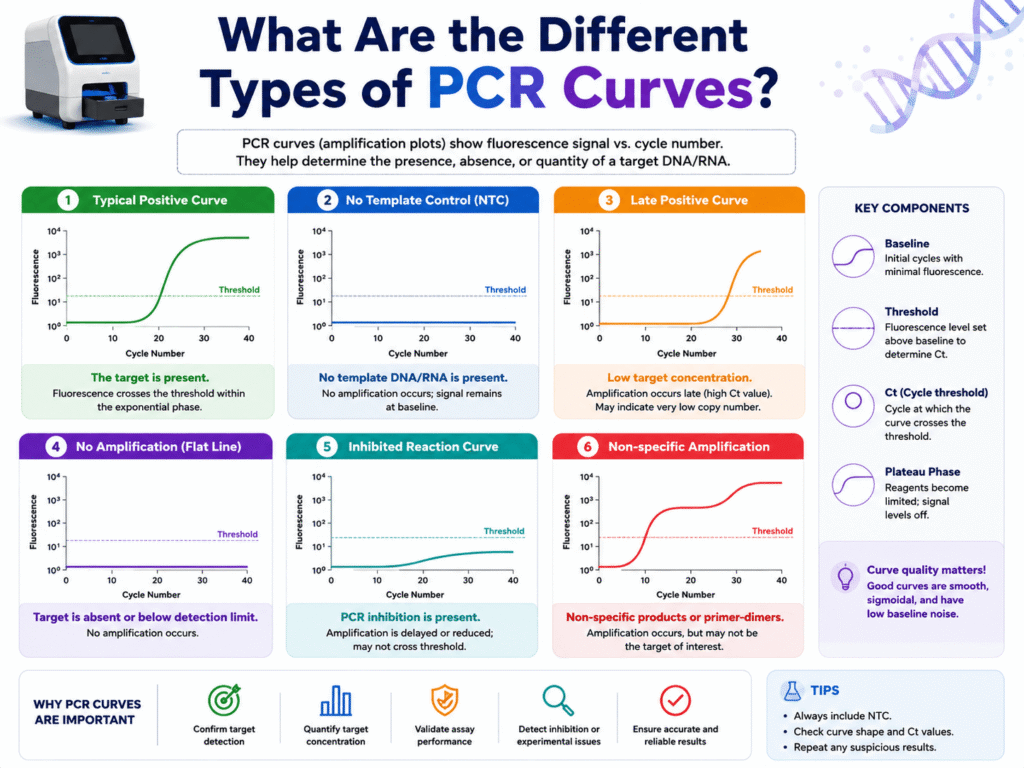
An amplification curve shows fluorescence rising across PCR cycles as the target sequence is copied. It is the main curve used in qPCR and RT-qPCR.
A clean amplification curve usually has an S-shaped pattern. It begins with a flat baseline, rises during exponential amplification, then reaches a plateau when the reaction slows.
Baseline curve
A baseline curve shows the early background fluorescence before the reaction produces enough signal to separate from noise.
This part of the graph helps software subtract background signal. A stable baseline makes Cq or Ct values more reliable. A drifting or noisy baseline can point to bubbles, poor sealing, evaporation, or optical issues.
Exponential curve
The exponential curve is the fast-rising part of the PCR curve where product increases most predictably.
This is the best region for quantification because the reaction is still efficient. A steep, smooth rise usually suggests good amplification. A shallow rise may point to inhibition, weak primer performance, or poor template quality.
Linear or log-linear curve
The linear or log-linear curve is the straight-line view of exponential amplification when the data is shown on a logarithmic scale.
This view helps compare the slope of different samples. Curves that rise in parallel usually behave similarly. Curves with different slopes may suggest different reaction efficiency or inhibition.
Plateau curve
The plateau curve is the late part of amplification where fluorescence stops rising even though cycling continues.
At this stage, reagents become limited and product formation slows. The plateau is not a good region for measuring starting template because reactions with different starting amounts can finish at similar fluorescence levels.
Melt curve
A melt curve shows how double-stranded PCR product separates as temperature increases after amplification.
This curve is mainly used in dye-based qPCR assays, such as SYBR Green assays. A clean melt curve supports the presence of the intended product, while an unusual melt pattern may suggest nonspecific amplification.
Derivative melt curve
A derivative melt curve changes the raw melt curve into peaks, making the melting temperature easier to read.
A single sharp peak usually suggests one main PCR product. Extra peaks can point to primer-dimers, off-target products, or mixed amplicons.
Standard curve
A standard curve compares Cq values with known template amounts.
It is used to measure PCR efficiency, dynamic range, and absolute quantity. A good standard curve should be straight across the tested dilution range and should show consistent amplification behavior.
Abnormal PCR curve
An abnormal PCR curve has an unusual shape, timing, or signal pattern.
Common abnormal curves include flat curves, late curves, noisy curves, shouldered curves, multi-peak melt curves, and primer-dimer curves. These patterns can come from weak template, inhibitors, contamination, poor primer design, bubbles, evaporation, or incorrect analysis settings.
| PCR curve type | What it shows | Main use |
| Amplification curve | Fluorescence rise across cycles | Detecting and measuring target amplification |
| Baseline curve | Early background signal | Setting background correction |
| Exponential curve | Rapid product doubling phase | Best region for quantification |
| Linear or log-linear curve | Straight-line view of exponential amplification | Cq and efficiency analysis |
| Plateau curve | Late phase where signal stops rising | Shows reagent depletion or reaction slowing |
| Melt curve | Fluorescence change as DNA melts | Checking product specificity |
| Derivative melt curve | Melt curve converted into peaks | Finding one product, primer-dimers, or off-target products |
| Standard curve | Cq values plotted against known template amounts | Measuring efficiency and absolute quantity |
| Abnormal curve | Odd, delayed, noisy, flat, or multi-phase pattern | Troubleshooting |
What is an amplification curve in PCR?
An amplification curve is the main qPCR curve. It shows fluorescence increasing as the target sequence is copied during each PCR cycle.
A normal amplification curve usually has a sigmoidal shape. It starts flat, rises quickly, then levels off. That shape reflects the early background signal, the rapid product-building phase, and the late stage where reaction components become limiting.
In qPCR analysis, the point where the curve crosses a set threshold is called the quantification cycle, or Cq. Many labs still use Ct, but MIQE guidance favors Cq because different instruments and software use slightly different threshold methods. The lower the Cq, the more starting target was present in the sample.
A strong amplification curve is usually smooth, well-separated from no-template controls, and shaped like a clean S. When replicate samples produce similar curves and similar Cq values, the run is easier to trust.
What is the baseline phase of a PCR curve?
The baseline phase is the early part of a qPCR curve where fluorescence is still close to background noise. The target may already be amplifying, but the signal is not yet strong enough to rise above the background.
This early phase often looks flat. The instrument is still collecting fluorescence, but the amount of product is too low to measure with confidence.
Baseline correction is part of qPCR data handling. Software subtracts background signal so the true amplification pattern can be seen. Poor baseline settings can shift Cq values, especially when curves are weak, noisy, or very early.
A clean baseline should be stable. A drifting baseline may come from bubbles, evaporation, poor sealing, optical issues, fluorescent contamination, or unusual sample chemistry. A noisy baseline can make threshold placement harder and may create false confidence in weak curves.
What is the exponential PCR curve?
The exponential curve is the rapid growth phase of PCR where product increases at the most predictable rate. In an ideal reaction, the target amount roughly doubles each cycle during this stage.
This phase is the heart of qPCR quantification. The relationship between cycle number and starting template is strongest here. When qPCR software calculates Cq, it tries to place the threshold in the region where amplification is clearly above background but not yet slowed by reagent limits.
PCR efficiency is also tied to this part of the curve. A perfectly efficient reaction would double product every cycle, but real reactions often fall short due to primer design, template complexity, inhibitors, enzyme limits, or reagent conditions. Analysis methods that use the exponential phase can estimate efficiency from the slope of baseline-corrected amplification data.
The exponential phase should look smooth and steep. A shallow rise may suggest low efficiency. A curve that rises too early in controls may point toward contamination or primer-dimer signal.
What is the linear or log-linear phase in qPCR?
The linear or log-linear phase is the portion of the amplification curve that appears as a straight line when fluorescence is plotted on a logarithmic scale. It represents the measurable part of exponential amplification.
Many qPCR plots can be viewed in linear scale or log scale. On a linear plot, the amplification curve looks like an S. On a log plot, the exponential part looks straighter, which makes it easier to compare reaction behavior.
This region helps researchers judge whether samples amplify in parallel. If two samples have the same assay efficiency, their curves should rise with similar slopes. If one curve is much flatter, the reaction may contain inhibitors, degraded template, poor primer binding, or another technical issue.
The log-linear region also helps separate real amplification from random noise. A true amplification curve usually shows a clean, sustained rise. Noise may jump once or twice but does not build in a steady pattern.
What is the plateau phase of a PCR curve?
The plateau phase is the late part of the amplification curve where fluorescence stops rising even though cycling continues. It happens when the PCR reaction begins to run out of active reagents or product formation slows.
The plateau is not a good region for quantification. At this stage, the amount of product no longer reflects the starting amount of template in a clean way. Two samples with very different starting quantities may end at similar fluorescence levels once both reactions reach saturation.
Several factors can shape the plateau:
- Polymerase activity drops after many cycles
- Primers and dNTPs become limiting
- Product reannealing competes with primer binding
- Fluorescent dye or probe signal reaches an upper range
- Reaction byproducts interfere with amplification
A high plateau does not always mean the sample had more starting DNA. A low plateau does not always mean the sample was weak. The earlier Cq and curve shape matter more than the final endpoint signal.
What is a melt curve in PCR?
A melt curve is a post-amplification curve that shows how double-stranded DNA separates as temperature increases. It is mainly used to check whether the PCR made the intended product.
Melt curve analysis is common in SYBR Green and other dye-based qPCR assays. The dye fluoresces when bound to double-stranded DNA. As the temperature rises, the DNA strands separate, the dye leaves the DNA, and fluorescence drops. The melting temperature, often called Tm, depends on the amplicon’s length, sequence, and GC content.
A clean melt curve usually points to one dominant product. A messy melt curve may show off-target products, primer-dimers, or mixed amplicons.
Probe-based assays, such as TaqMan assays, often do not rely on melt curves in the same way because probe binding adds specificity during amplification. Dye-based assays need melt curve review more often because the dye can bind any double-stranded DNA, including unwanted products.
What is a derivative melt curve?
A derivative melt curve converts the melt curve into peaks, making it easier to see product melting temperatures. A single sharp peak usually suggests one main PCR product.
Instead of reading the raw fluorescence drop, software plots the rate of fluorescence change against temperature. The point where the DNA melts fastest becomes a peak.
A clean derivative melt curve usually has:
- One sharp peak at the expected Tm
- No strong secondary peaks
- No low-temperature primer-dimer peak
- Similar Tm values across replicates
A second peak can mean a nonspecific amplicon. A small low-temperature peak often suggests primer-dimers because short DNA fragments usually melt at lower temperatures than the intended product.
A single peak is reassuring, but it is not perfect proof. Some unwanted products can melt near the same temperature as the target. That is why assay validation may also use gel electrophoresis, sequencing, controls, or probe-based confirmation when the result carries clinical, regulatory, or high-value research weight. Primer design work has shown that melt curve interpretation can be more complex than it appears, especially with dye behavior and product mixtures.
What is a standard curve in PCR?
A standard curve is a qPCR graph made from known template concentrations. It is used to measure assay efficiency and estimate the amount of target in unknown samples.
To make a standard curve, a lab runs serial dilutions of a known template. The Cq values are plotted against the log of the starting quantity. A good standard curve should be straight across the tested range.
The slope of the curve is used to estimate PCR efficiency. Many qPCR assays aim for efficiency near 90% to 110%, though acceptance ranges depend on the lab, assay type, sample type, and reporting rules.
A standard curve can also show the dynamic range of the assay. That range tells the user where the assay gives reliable measurements. Samples outside that range may need dilution, repeat testing, or a different method.
Absolute quantification depends heavily on good standards. If the standards are degraded, poorly diluted, contaminated, or not matched well to the sample matrix, the final copy-number estimate can be wrong even when the amplification curves look neat.
What is a no-amplification curve?
A no-amplification curve is a flat qPCR curve that never crosses the threshold. It usually means the target was not detected, but it can also mean the reaction failed.
A flat curve in a sample can happen when the target is absent. That is the simplest reading.
Still, a no-amplification result should be read alongside controls. If the positive control amplified and the internal control worked, a flat target curve may be a true negative. If controls failed, the result is not reliable.
Common reasons for a flat curve include:
- No target template in the sample
- Very low target below the assay’s detection limit
- PCR inhibitors in the sample
- Degraded DNA or RNA
- Wrong primer or probe setup
- Missing reagent
- Instrument or plate setup error
A no-template control should stay flat. If it amplifies, contamination or primer-dimer signal may be present.
What is a late amplification curve?
A late amplification curve crosses the threshold after many cycles. It may show a very low amount of target, but it can also reflect nonspecific amplification, contamination, or background signal.
Late curves need careful reading. A curve that appears near the end of cycling may be real when the assay is highly sensitive and controls are clean. The same type of curve may be questionable if no-template controls also rise late or if melt curves show extra peaks.
Many labs set a Cq cutoff based on validation data. A result beyond that cutoff may be called inconclusive, repeat needed, or below the reliable reporting range.
Late amplification is common in low-copy samples, degraded specimens, environmental samples, wastewater work, forensic traces, or weak RNA extracts. It can also happen when inhibitors slow the reaction.
A clean late curve should still have a recognizable amplification shape. Random upward drift, one-cycle spikes, or uneven noise should not be treated like a true positive without supporting evidence.
What is a noisy PCR curve?
A noisy PCR curve shows irregular fluorescence changes instead of a smooth rise. Noise can appear in the baseline, the exponential phase, or the plateau.
Small noise is normal. Instruments measure fluorescence across tiny reaction volumes, and minor variation can occur. Large noise makes results harder to read.
Noisy curves can come from bubbles, dust, poor optical sealing, evaporation, low reaction volume, pipetting variation, dirty plates, poor mixing, or low fluorescence signal. A single bad well among clean replicates often points to a handling issue. Noise across many wells may point to reagents, instrument settings, or plate problems.
When a noisy curve still crosses the threshold, the Cq may be unreliable. Replicates, melt curve data, controls, and repeat testing become more valuable.
What is a multi-phase or shouldered PCR curve?
A multi-phase PCR curve rises in more than one step or shows a shoulder before the main rise. It may suggest mixed products, inhibition, primer competition, or data processing issues.
A normal amplification curve rises smoothly. A shouldered curve may look like it starts to amplify, slows down, then rises again. Sometimes this happens when more than one product contributes to fluorescence at different points in the reaction.
In multiplex PCR, curve shapes can become more complex because several targets and probes share the same reaction space. Primer competition, probe signal differences, or target imbalance can affect curve shape.
In singleplex dye-based qPCR, a shoulder may suggest nonspecific amplification or primer-dimer formation. Melt curve analysis can help separate one clean product from mixed products.
What is a primer-dimer curve?
A primer-dimer curve is an amplification signal caused by primers binding to each other instead of the intended target. It is most visible in dye-based qPCR because the dye detects any double-stranded DNA.
Primer-dimers often appear as late amplification in no-template controls. On a derivative melt curve, they often produce a lower-temperature peak than the true amplicon.
Primer-dimers can steal reagents from the intended reaction, reduce sensitivity, and create false-positive signals. Hot-start polymerases, better primer design, adjusted primer concentration, annealing temperature changes, and cleaner reaction setup can reduce this problem. Research on nonspecific qPCR products has linked assay artifacts to primer interactions and unwanted amplification routes, especially when reaction components interact before the intended cycling conditions fully begin.
A small primer-dimer peak may not ruin every assay, but it becomes a problem when it overlaps with low-copy target detection or appears in controls.
What is an inhibition curve in PCR?
An inhibition curve is an amplification curve that rises later, flatter, or weaker than expected because something in the sample slows the PCR reaction.
PCR inhibitors can come from blood, stool, soil, plant tissue, food matrices, extraction chemicals, heme, salts, ethanol, phenol, humic acids, or carryover compounds from sample prep.
Inhibition can make a positive sample look weak or negative. That is why many diagnostic and research workflows include internal controls. If the internal control shifts later or fails, inhibition may be present.
A dilution series can also reveal inhibition. When a sample is diluted, inhibitors may become less concentrated. If the diluted sample amplifies better than expected, inhibition is likely.
Curve shape gives the first clue. A flatter slope, delayed Cq, or poor replicate agreement can suggest that the reaction chemistry is being held back.
What is a high-resolution melt curve?
A high-resolution melt curve, often called an HRM curve, is a more sensitive melt analysis used to detect small sequence differences. It can help identify variants, mutations, methylation changes, or genotype differences.
HRM uses precise temperature control and high-density fluorescence readings. Instead of only asking whether there is one product, HRM compares the detailed melting pattern of amplicons.
Two products may have similar size but different sequence. Even a small base change can alter melting behavior enough for HRM software to separate curves into groups.
HRM is different from a basic melt curve. A basic melt curve is often used as a product-specificity check after qPCR. HRM is a genotyping or variant-screening method that needs tighter assay design, cleaner amplicons, and more careful controls.
How do PCR curves differ from qPCR curves?
PCR curves usually refer to graphs produced during real-time PCR or after melt analysis, while conventional PCR usually produces endpoint results such as gel bands.
The word “PCR curve” can be broad. In many lab conversations, it really means a qPCR amplification curve. In other cases, it may mean a melt curve, standard curve, or HRM curve.
Conventional PCR does not measure fluorescence at every cycle in the same way. It amplifies the target, then the final product is checked after the run. qPCR measures signal during the run, which is why curve shape becomes part of interpretation.
RT-qPCR adds one more step: RNA is converted into cDNA first. The amplification curve still looks like a qPCR curve, but sample quality and reverse transcription efficiency add another layer of variation.
How do you know if a PCR curve is good?
A good PCR curve is smooth, reproducible, clearly separated from negative controls, and supported by the expected melt curve or probe signal.
A strong qPCR result usually has several signs working together. The amplification curve has a stable baseline, a clean exponential rise, and a reasonable Cq for that assay. Replicates cluster closely. Negative controls stay negative. Positive controls amplify as expected. Dye-based assays show one expected melt peak.
No single curve feature tells the whole story. A neat amplification curve with a bad melt curve may still be nonspecific. A late curve with clean controls may be a low-positive result, but a late curve with control amplification may be contamination.
Good interpretation asks for agreement between curve shape, Cq, controls, assay validation, and sample context. MIQE-style reporting has long pushed qPCR users to provide enough experimental detail for others to judge reliability, rather than treating one number as the whole result.
What do abnormal PCR curves usually mean?
Abnormal PCR curves usually point to weak template, inhibition, primer-dimers, nonspecific products, contamination, setup errors, optical problems, or poor analysis settings.
A flat curve may be a true negative, or it may be a failed reaction. A late curve may be low target, or it may be background amplification. A noisy curve may come from bubbles or low signal. A multi-peak melt curve may show more than one product.
The safest way to read abnormal curves is to compare them with controls and replicates. One strange well may be a pipetting or sealing issue. A pattern across many wells may point to primers, reagents, cycling settings, or sample extraction.
Abnormal curves should not be cleaned up only through software settings. Baseline and threshold adjustments can help display the data more clearly, but they cannot fix bad chemistry. Repeating the run, checking controls, reviewing melt peaks, and confirming product size may be needed.
Types of PCR curves and what they tell you
Different PCR curves answer different questions. The amplification curve asks whether and when product appeared. The melt curve asks whether the product looks specific. The standard curve asks whether the assay measures known concentrations properly.
Here is the easiest way to remember them:
- The amplification curve is about detection and quantity
- The melt curve is about product identity
- The standard curve is about assay performance
- The abnormal curve is about troubleshooting
A lab result becomes stronger when these curves agree. A clean amplification curve, one expected melt peak, strong controls, and a valid standard curve give much more confidence than any single curve alone.
PCR curves become clearer when you read the shape, not just the number
PCR curves are more than software graphics. They are a record of how the reaction behaved inside the tube. A Cq value may look tidy in a spreadsheet, but the curve behind it tells you whether the number deserves trust.
The best habit is simple: read the curve before accepting the result. Check the baseline. Look at the rise. Compare replicates. Review the melt peak when using dye-based chemistry. Confirm that controls behaved as expected.
A good PCR curve does not need to look perfect. Real samples are messy. Yet when you learn the curve types, the graph stops feeling like a mystery and starts acting like a warning system. That is where better PCR interpretation begins.